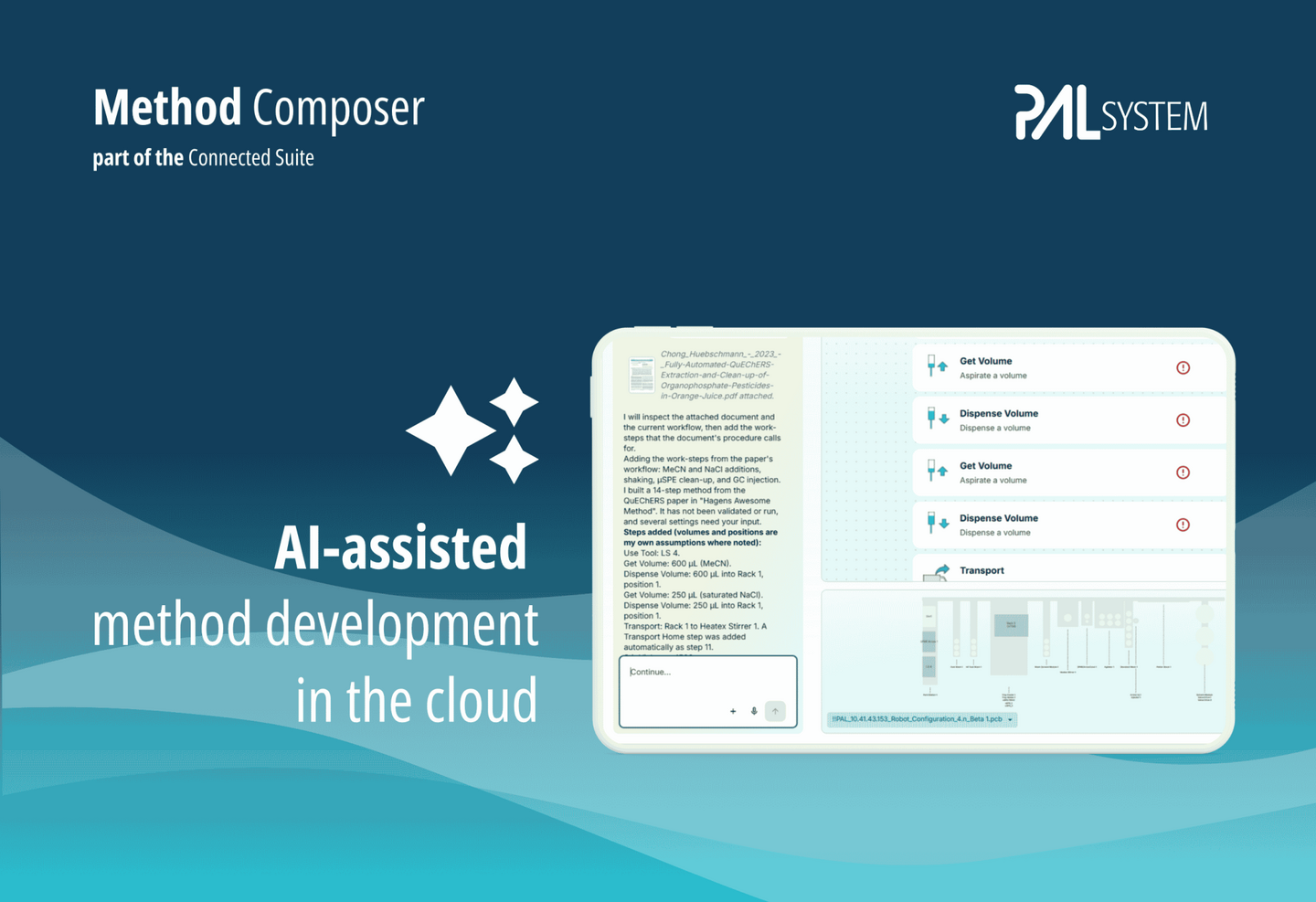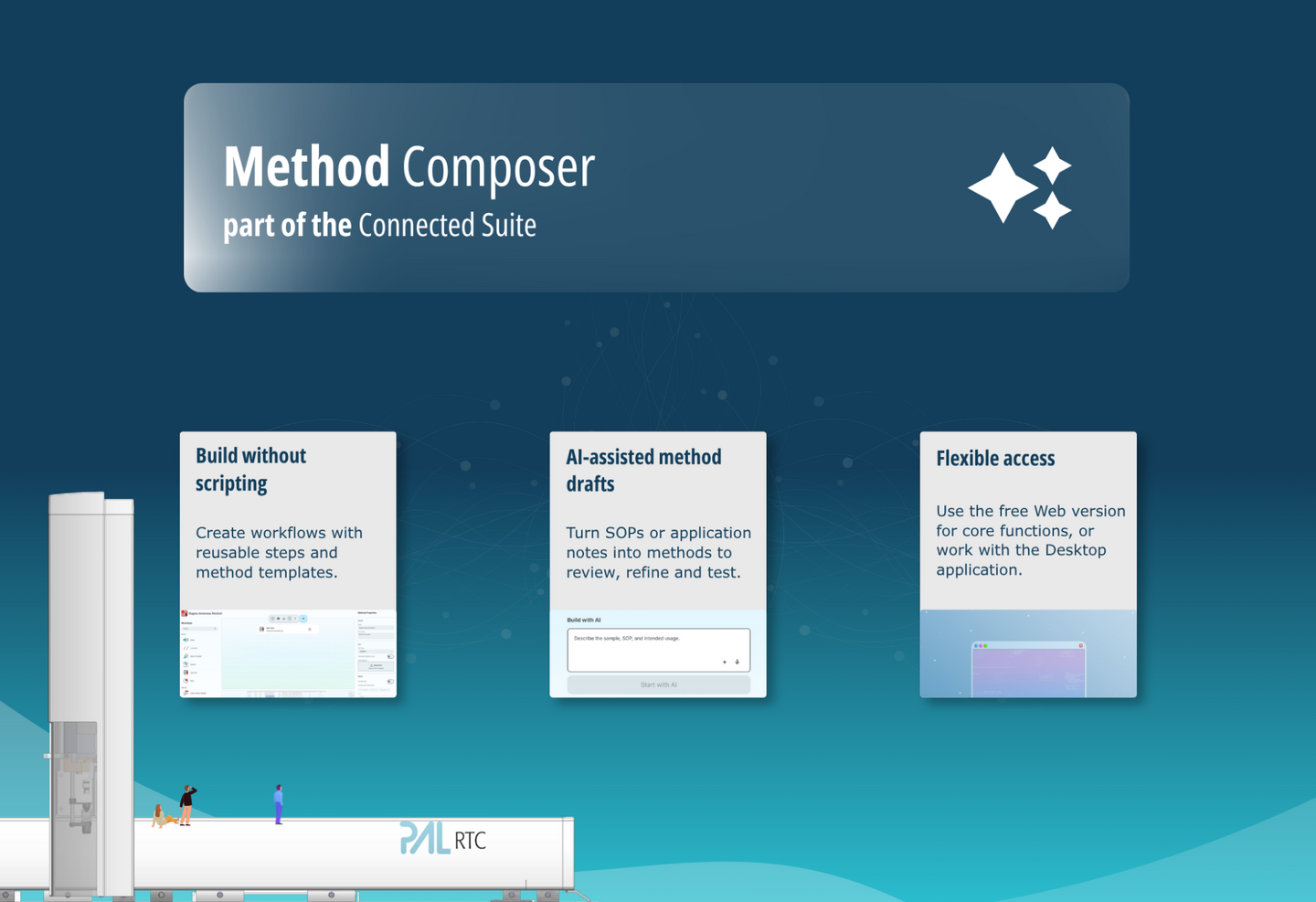
The new Method Composer helps turn SOPs, protocols, papers and application notes into automation-ready method drafts.
Story
Automation
10 min 11.17.2026

From laboratory protocol to automated workflow: Meet the new Method Composer

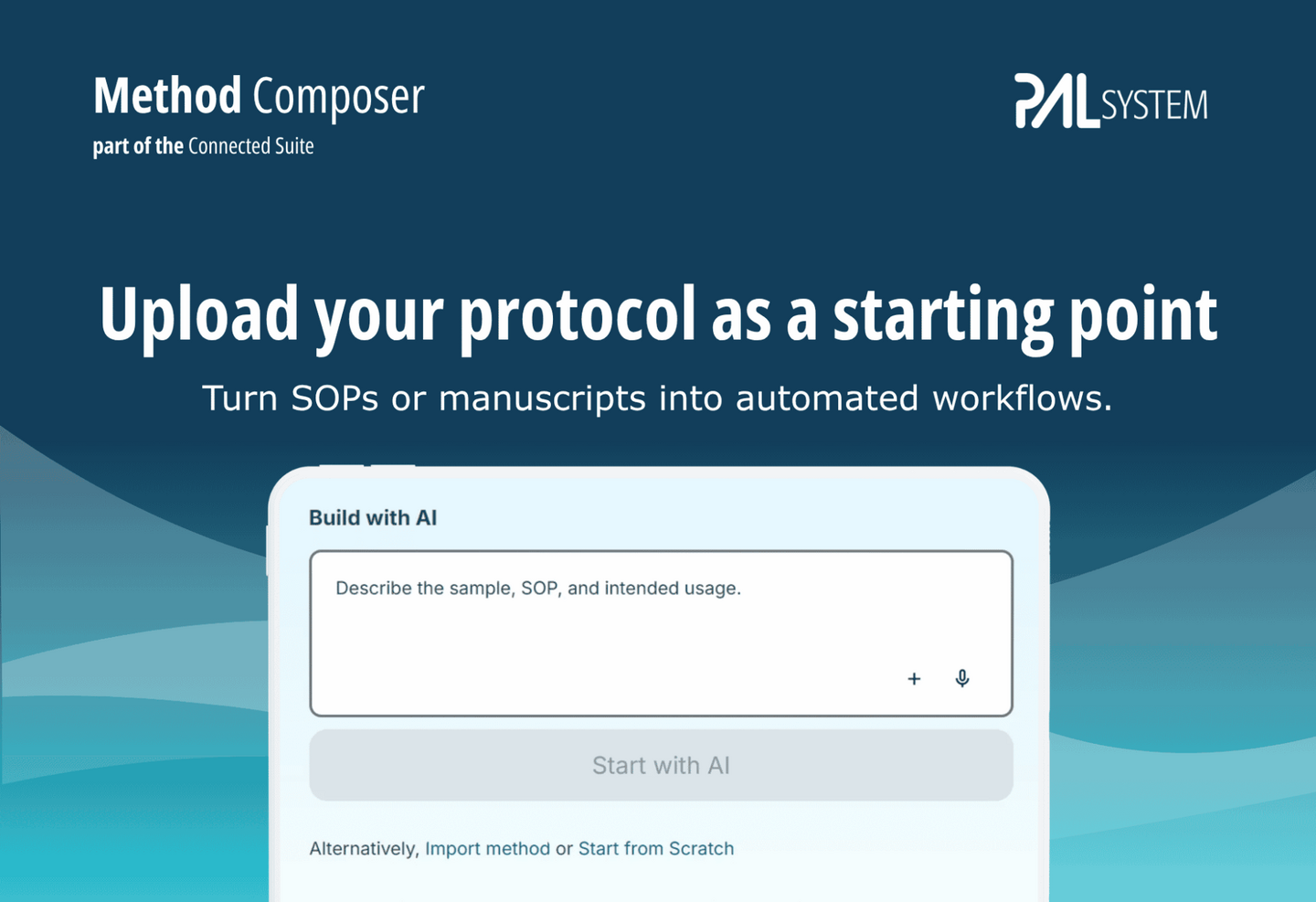
Laboratory automation often starts with a protocol that already works. The new Method Composer helps turn SOPs, protocols, papers and application notes into automation-ready method drafts. Upload a document or describe your application, and the integrated AI Assistant can propose a first workflow for you to review, refine and adapt to your laboratory. Or build your method directly from predefined worksteps, templates or existing methods, in the browser or with the desktop version.

From automated sample preparation to LC/MS or GC/MS analysis, PAL System connects your protocol with the analytical workflow.

Try the new Method Composer in the browser-based Connected Suite for free.

Gegner Hagen
Hagen Gegner

Scientific Communications Specialist

Visit Bio

The Method Composer helps turn that scientific procedure into an automated workflow. Upload an existing document or describe the application in your own words. The integrated AI Assistant can use that information to create a first method draft based on available worksteps. You can then review the proposed method, adjust parameters, change the sequence, and add or remove worksteps as needed. You remain in control of the final method.

Start with the protocol you already have

If you want to automate a laboratory protocol, you should not have to start with software code. The procedure may already be documented in a standard operating procedure (SOP), protocol, manuscript, paper or application note. However, automation requires explicit instructions. Each operation needs to become a defined step: which tool to use, how much liquid to aspirate, where to dispense it, how long to mix, and when to inject the prepared sample.

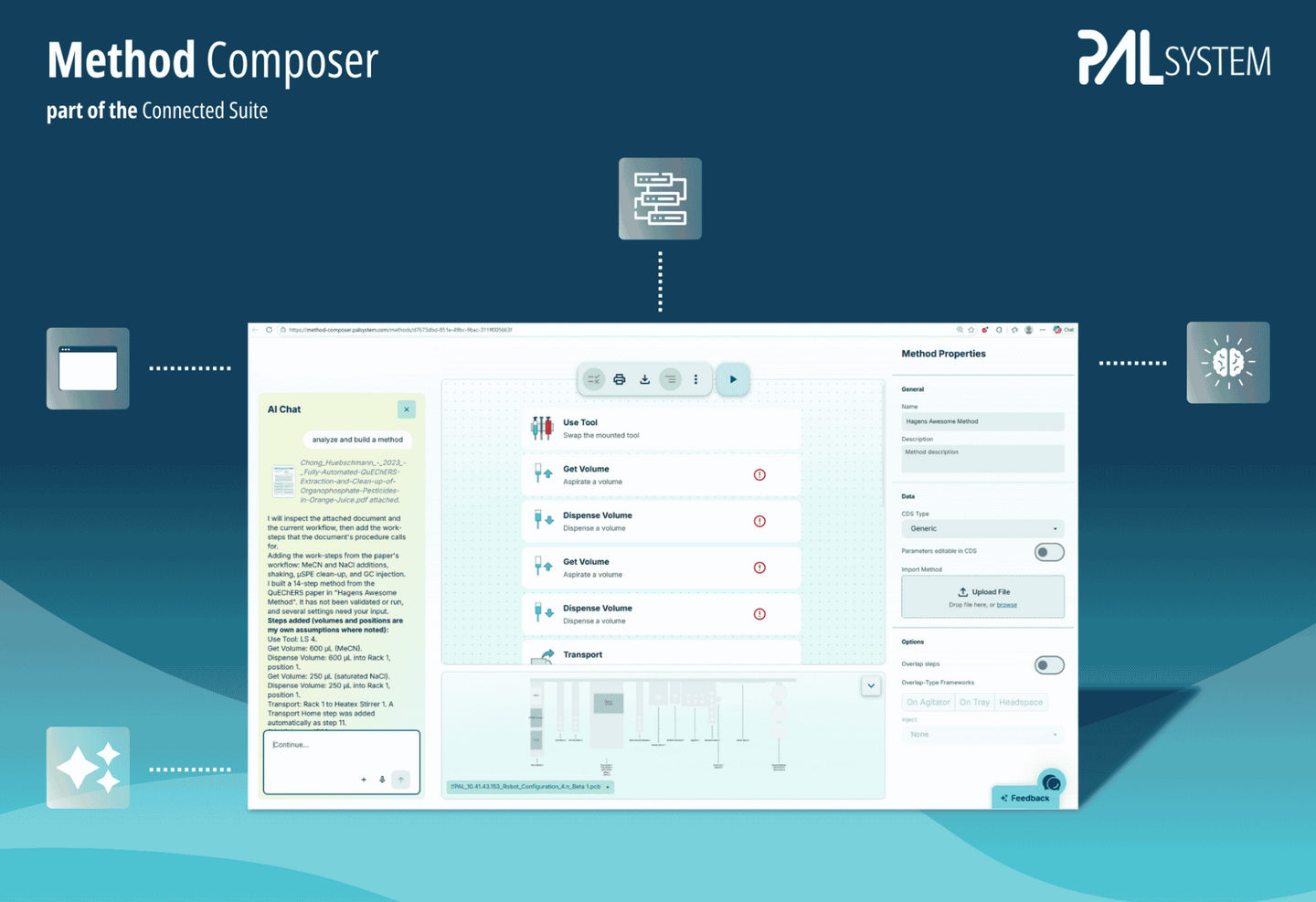
The Method Composer in the online Connected Suite, helps turn that scientific procedure into an automated workflow. Upload an existing document or describe the application in your own words. The integrated AI Assistant can use that information to create a first method draft based on available worksteps. You can then review the proposed method, adjust parameters, change the sequence, and add or remove worksteps as needed. You remain in control of the final method.

PAL AI then helps translate the information into a method draft based on available PAL System worksteps. As a result, scientists can focus on the application rather than starting with a blank method or writing scripts.

From protocol to an automated laboratory workflow

The Method Composer represents laboratory operations as predefined worksteps. These can cover control operations, cleaning, liquid handling, sample preparation, LC or GC signals, and different injection methods. For example, sample preparation worksteps can include transporting vials, centrifugation, stirring, vortexing and temperature control. New worksteps extend these capabilities to the Pipette Tool, including liquid handling with liquid level detection, as well as FlipTube handling. You can build a method from scratch, start with a template or modify an existing method. The established graphical approach remains available, including drag-and-drop method creation and automatic validity checks.

The new browser-based Connected Suite expands these starting points. You can describe an application in natural language or provide an existing document. The AI Assistant then helps translate that information into a method draft using worksteps available for the selected system configuration. This provides a faster starting point while keeping the method open for review and refinement.

The chromatography data system, or CDS, remains responsible for chromatographic data acquisition, processing and reporting. Method Composer creates the PAL System method and supports its integration into the wider chromatography workflow. This distinction can be made during the method development process and can be changed at any point.

Connect automated sample preparation with LC/MS or GC/MS

Laboratory protocol automation does not have to end with a single sample preparation step. In an analytical workflow, the prepared sample ultimately needs to reach the measurement system. Depending on its configuration, PAL System can combine sample handling, preparation and injection within the same automated workflow.

The Method Composer makes these workflows visible as individual worksteps. This includes routine liquid handling as well as more specialized sample preparation and injection workflows, such as µSPE or SPME. For LC/MS and GC/MS applications, preparation and injection steps can be combined with the signals needed to coordinate the PAL workflow with the analytical system. This connects automated sample preparation with downstream liquid chromatography-mass spectrometry (LC/MS) or gas chromatography-mass spectrometry (GC/MS) analysis. The chromatography data system (CDS) remains responsible for chromatographic data acquisition, processing and reporting. Method Composer creates the automation method and supports its integration into the wider analytical workflow.


Build visually, validate and prepare the method for your CDS

You can still build methods from predefined worksteps, start with a template, modify an existing method or import a method. The familiar graphical approach remains, allowing you to build the sequence visually and adapt individual worksteps and parameters to your application. This workflow is available both in the browser-based Connected Suite and in the Method Composer desktop version for local method development. The desktop version includes the expanded workstep library, including the new PAL Pipette Tool (LLD FT) worksteps, but does not include the AI Assistant. The PAL Pipette Tool worksteps extend the range of liquid-handling operations that can be represented in Method Composer, including liquid level detection and FlipTube handling. This makes the expanded workstep library available whether you choose the browser-based environment or work locally with the desktop version.

During method setup, real-time validation helps identify missing or inconsistent content. If a PAL System is connected, you can also perform a test run before taking the method into your analytical workflow. CDS-aware parameters support integration with chromatography data systems, and the completed method can be exported for CDS execution. 


Ask the AI Assistant while you build

For users working in the browser-based Method Composer, the AI Assistant adds another way to develop and refine a method. It does more than help create the first method draft. You can also ask questions while developing your method, bringing PAL System expertise directly into your Connected Suite. Instead of leaving the application to search for information elsewhere, you can ask about products, applications, methods or technical questions as they arise.

The AI Assistant draws on PAL System knowledge sources such as product documentation, application information, service knowledge and existing methods. It provides guidance while you remain responsible for reviewing the method and confirming that it is suitable for your application and PAL System configuration.


Users can create and adapt their methods without purchasing a Method Composer license for those core web functions.

Available in the browser and free to start

The new Method Composer is part of the PAL System Connected Suite, bringing method development with the integrated AI Assistant directly into the browser. You can save methods to your account and access them online without installing dedicated software.

The web version is free of charge for its core functionality, so you can create and adapt methods without purchasing a Method Composer software license. This makes it easy to explore how an existing laboratory protocol could become an automated workflow.

Help shape the next laboratory companion

This launch is also an invitation to participate.

We want to learn which protocols you want to automate, where the AI Assistant provides a useful starting point, and how the Connected Suite can become an even more useful companion in your laboratory.

Upload a protocol. Build a workflow. Try it on your PAL System. And tell us what works and what we can improve. Our goal is simple: help more scientists turn their application knowledge into reliable automated workflows, from sample preparation to analytical measurement.


Ready to automate your laboratory protocol?

Try the Method Composer for free in your browser. 

Upload an existing protocol, describe your application, or start building your method from predefined worksteps. The web version is free of charge for its core functionality.

Contact LinkedIn