Tracking Biological Cultures with Automated Headspace Sampling
A Conversation with Dr. Christopher Rosin, Senior Application Scientist at G.A.S. Dortmund
Repeated headspace sampling is a powerful tool for studying biological systems over time. However, obtaining reliable measurements from blood cultures, microbial samples, or other biological matrices presents a challenge: researchers need to collect multiple samples throughout an experiment while minimizing carry-over and maintaining consistent sampling conditions.
At G.A.S. Gesellschaft für analytische Sensorsysteme mbH in Dortmund, a patented closure attachment was developed to support automated serial headspace sampling using PAL automation. We spoke with Dr. Christopher Rosin, Senior Application Scientist at G.A.S., about the analytical challenges that inspired the development, the role of automation, and future opportunities for time-resolved biological monitoring.
Hagen Gegner
Scientific Communications Specialist
Visit Bio
About the Scientist
Christopher Rosin is a Senior Application Scientist at G.A.S. Dortmund, where he focuses on application development for tailor-made Gas Chromatography-Ion Mobility Spectrometry (GC-IMS) systems. With an academic background in molecular biology, biophysical chemistry, and biochemical analytics, he completed his PhD in Biophysical Chemistry & Biochemical Analytics at the Technical University of Dortmund in 2015 after studying Molecular Biology at the Westphalian University of Applied Sciences.
Over more than a decade, his work has supported analytical solutions in areas including food authenticity testing, sustainable energy quality control for hydrogen, biogas, and natural gas, toxic industrial chemical detection, and non-invasive clinical diagnostics.
The Challenge of Repeated Sampling
What analytical bottleneck originally led to the development of the closure attachment?
Christopher Rosin:
"The primary bottleneck we faced in high-throughput analytical routines was sample-to-sample carry-over and cross-contamination. When a conventional autosampler needle penetrates standard vial septa repeatedly, biological residues, condensation, or aerosol micro-droplets can adhere to the needle's outer surface and be transferred to subsequent samples.
For trace-level headspace analysis, especially when monitoring microbial kinetics or volatile biomarkers, even very small amounts of contamination can influence the result. We needed a dedicated closure attachment that mechanically isolates the needle path and prevents the transfer of contaminants from one sample vessel to the next."
Creating a Controlled Sampling Interface
How does the closure attachment support automated serial headspace measurements?
Christopher Rosin:
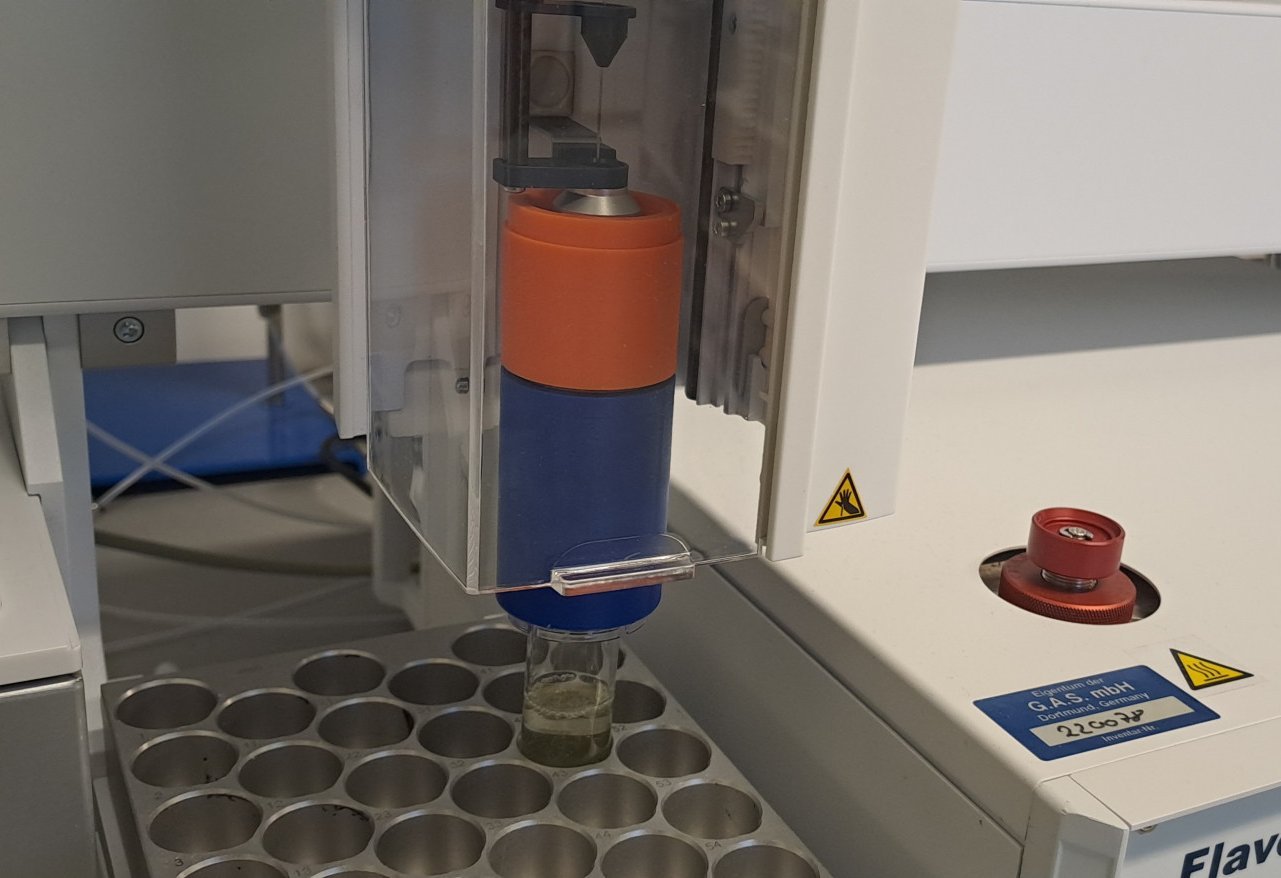
"The patented closure attachment creates a decoupled transfer interface. Instead of exposing the primary vial septum directly, the system uses a guided entry channel and an intermediate containment zone.
When the autosampler needle engages, it is precisely centered and guided through defined sealing elements. This architecture helps maintain a controlled interface throughout repeated sampling cycles."
The patented closure attachment was developed for use with standard headspace vials and blood culture flasks and forms the basis of a workflow designed for repeated automated sampling of biological specimens. The patent is assigned to G.A.S. Gesellschaft für analytische Sensorsysteme mbH under European Patent EP 4 308 295 B1.
Automated Monitoring of Blood Cultures
Your team evaluated the approach using blood culture studies. What stood out to you most?
Christopher Rosin:
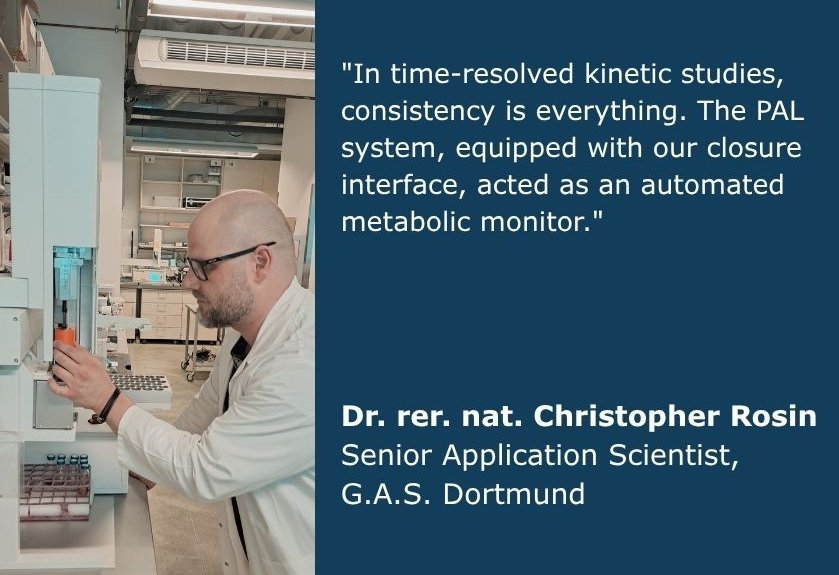
"In time-resolved kinetic studies, consistency is everything. The PAL System, equipped with our closure interface, acted as an automated metabolic monitor. By sampling small headspace aliquots at defined intervals, we were able to track volatile changes while the cultures remained under incubation."
Blood culture workflows create a particularly demanding analytical environment due to the complex mixture of compounds released from the growth medium and biological matrix. According to Christopher Rosin, reliable monitoring requires both reproducible sample introduction and sensitive analytical detection.
Christopher Rosin:
"Blood culture bottles can produce a heavy baseline of background volatiles. Resolving microbial signals requires two synchronized pillars: reproducible sample delivery and sensitive detection. The closure interface delivers highly reproducible headspace sampling, while GC-IMS provides orthogonal separation through gas chromatography and ion mobility."
For Christopher Rosin, the broader significance extends beyond a single application:
"My primary take-home message is that metabolic VOC kinetic profiling can reveal biological changes much earlier than traditional growth-based observations. Automated headspace extraction transforms analysis from a passive process into a continuous monitoring approach."
You can read the full publication here: Blood Culture Headspace Gas Analysis Enables Early Detection of Escherichia coli Bacteremia in an Animal Model of Sepsis
Is the concept limited to GC-IMS workflows?
Christopher Rosin:
"The adapter operates on the front-end sampling side of the workflow. The fundamental objective is maintaining sample integrity during repeated headspace measurements.
Whether the detector is GC-IMS or GC-MS, the goal remains the same: reliable sample introduction, reduced carry-over, and reproducible sampling conditions. High-quality analytical data always begins with maintaining sample integrity at the point of sampling."
Looking Ahead
Where do you see the greatest future potential for this approach?
Christopher Rosin:
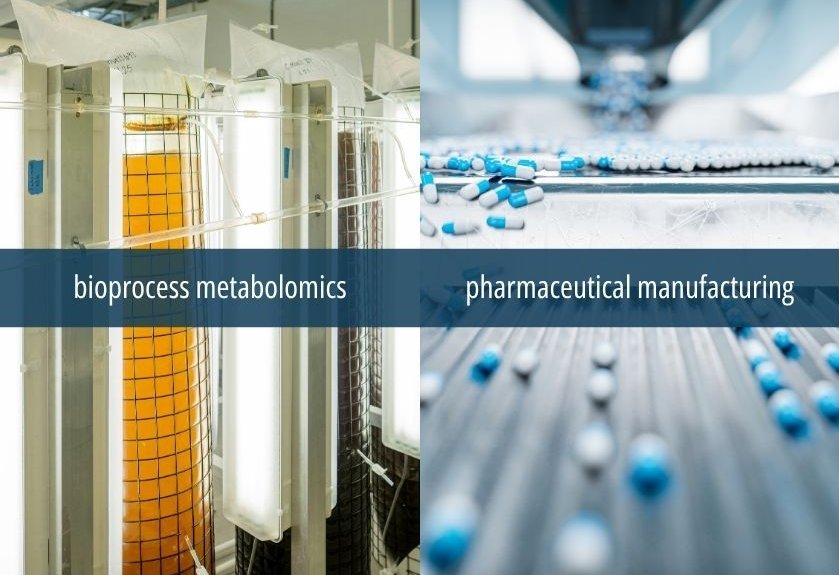
"The immediate frontier is real-time bioprocess and live-cell metabolomics. Continuous sterile headspace tracking allows researchers to monitor cell health, nutrient utilization, and metabolic activity without repeated liquid sampling.
Another promising area is pharmaceutical manufacturing, where automated monitoring of headspace composition may support future quality-control workflows. More broadly, I see considerable opportunity wherever researchers want to monitor biological systems over time while minimizing disruption to the ongoing process."
Interested in discussing automated headspace sampling, GC-IMS applications, or customized analytical workflows?
Get in Touch
To discuss the closure attachment, automated headspace sampling workflows, custom vessel configurations, or GC-IMS and GC-MS applications, contact the G.A.S. Dortmund team:
Email: Contact G.A.S. Dortmund
Useful Links
About G.A.S. Dortmund
Headquartered at the BioMedicineCenter on the Technical University of Dortmund campus, G.A.S. Gesellschaft für analytische Sensorsysteme mbH develops analytical solutions based on Gas Chromatography-Ion Mobility Spectrometry (GC-IMS). The company specializes in applications ranging from food authenticity and process analytics to environmental monitoring and clinical research. Its portfolio includes the FlavourSpec®, BreathSpec®, GC-IMS systems, VOCal software, and specialized gas handling technologies.
References
- Rosin et al., Closure Attachment, European Patent EP 4 308 295 B1.
- Drees et al., Applied Microbiology and Biotechnology 103, 9091-9101 (2019).
- Euler et al., Antibiotics 11(8), 992 (2022).