
PAL Systems for PFAS Analysis

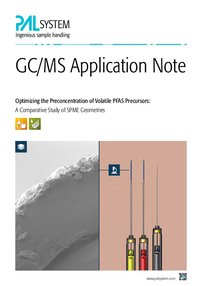
Optimizing the Preconcentration of Volatile PFAS Precursors - A Comparative Study of SPME Geometries
This Application Note summarizes a study by Williams et al. (2025) that performs a comprehensive comparison of two Solid Phase Microextraction (SPME) geometries: the traditional SPME Fiber and the robust SPME Arrow. The study systematically evaluates the impact of SPME geometry and extraction mode (Headspace vs. Direct Immersion) on extraction efficiency. The results provide a clear, data-driven basis for method development, showing how SPME configurations can be optimized for the specific physicochemical properties of different PFAS analytes.
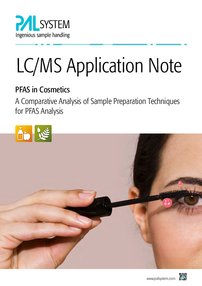
PFAS in Cosmetics -A Comparative Analysis of Sample Preparation Techniques for PFAS Analysis
This application note explores a comparative study that tackles this challenge head-on by evaluating two powerful sample preparation techniques: Solid Phase Microextraction (SPME) and Micro Solid Phase Extraction (µSPE) for analyzing eight key PFAS in mascara by Liquid Chromatography with Mass Spectrometry (LC/MS). The investigation revealed that the two methods offer complementary strengths. SPME proved more sensitive for water-soluble PFAS and offered a simpler, filtration-free workflow. In contrast, automated µSPE excelled for oil-soluble PFAS but required a sample filtration step.
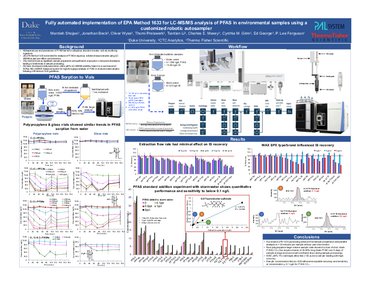
ASMS 2025 - Fully automated implementation of EPA Method 1633 for LC-MS/MS analysis of PFAS in environmental samples using a customized robotic autosampler
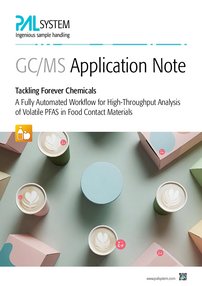
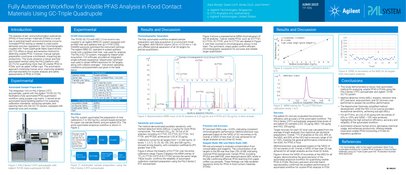
ASMS 2025 - Fully Automated Workflow for Volatile PFAS Analysis in Food Contact Materials Using GC-Triple Quadrupole
Gas Chromatography coupled with Triple Quadrupole Mass Spectrometry (GC/TQ) offers a robust and sensitive method for
detecting volatile PFAS. However, manual sample preparation could pose a bottleneck, impacting lab productivity. This study presents a robust and fully automated method using the PAL3 platform with GC/TQ for quantifying more than 30 volatile PFAS in FCMs, such as paper coffee cups. The automation approach minimizes human error, improving reliability
and reproducibility for routine analysis and safety assessments of PFAS in FCMs.
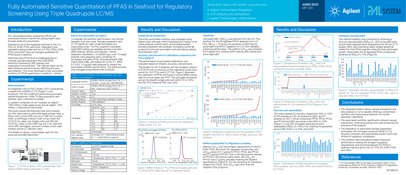
ASMS 2025 - Fully Automated Sensitive Quantitation of PFAS in Seafood for Regulatory Screening Using Triple Quadrupole LC/MS
Detecting trace PFAS level is challenging due to complex sample preparation like QuEChERS extraction followed by SPE cleanup, and evaporation/reconstitution. The manual steps can be labor-intensive and error-prone, affecting accuracy and reliability. This study developed a fully automated workflow for PFAS quantitation in seafood – shrimp.
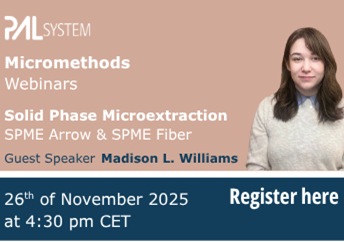
Micromethods - Modern SPME Geometries - A Focus on Volatile PFAS Analysis
If you're looking for ways to improve your analysis of complex matrices or trace contaminants, these expert-led sessions are for you
Join us for a deep dive into recent research comparing SPME Fiber and SPME Arrow for ultra-trace volatile PFAS. Learn directly from the author which geometry and extraction mode provides the best performance.
Advancing PFAS Analysis - Robotic Automation and Streamlined LC/MS Workflows
To support the scientific community and advance PFAS analysis we are proud to offer a webinar on this topic.
Key topics:
Sample Preparation Compendium
Automated, Green, and Efficient
A Compendium on Micromethods in Analytical Sample Preparation
Discover robust, precise, and reliable analytical methods while following the principles of Green Analytical Chemistry in various fields such as Food & Food Safety, Environmental, Clinical, Life Science, and Chemical.