The manual d-SPE step in QuEChERS workflows can be a bottleneck. Learn how the PAL System automates µSPE cleanup, offering a faster, cleaner, and greener solution for food safety, environmental analysis, and beyond.
Reach out and set it up with our Swiss partners from Brechbühler.
The QuEChERS (Quick, Easy, Cheap, Effective, Rugged, and Safe) method is a cornerstone in analytical laboratories for pesticide residue analysis. While the extraction is efficient, the traditional cleanup step, known as dispersive Solid Phase Extraction (d-SPE), often remains a manual, time-consuming process. PAL System is proud to collaborate with our trusted Swiss partner, Brechbühler AG, to bring advanced automated sample preparation solutions to local laboratories.
One of the most impactful of these is the automation of µSPE for QuEChERS extracts, representing a significant step forward in lab automation and efficiency.
The Challenge with Traditional d-SPE Cleanup
The standard d-SPE step involves adding a sorbent powder directly to the sample extract to bind and remove matrix components like fats, sugars, and pigments. While effective to a degree, this manual process has several limitations:
Limited Selectivity: The cleanup is often not exhaustive, leaving behind matrix components that can contaminate the GC-MS or LC-MS system.
Manual Labor: The process is repetitive and operator-dependent, introducing potential variability and consuming valuable analyst time.
Lack of Traceability: Manual steps are difficult to track precisely, which can be a challenge in regulated environments.
This is where automation and miniaturization offer a clear advantage.
Micro Solid Phase Extraction (µSPE) replaces the manual d-SPE step with a miniaturized, cartridge-based SPE cleanup that is fully automated on the PAL RTC.
A key strength of µSPE is its versatility, allowing for two primary modes of operation depending on the analytical goal:
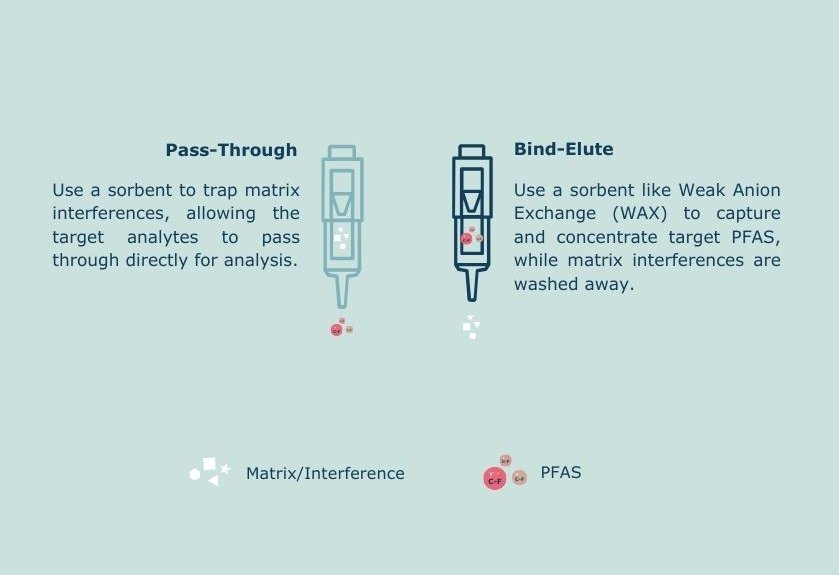
Pass-Through Mode (Cleanup): For applications like QuEChERS cleanup, µSPE operates in a "pass-through mode". Think of it like a highly efficient filter: the sorbent acts as a scavenger, trapping and removing unwanted matrix components while letting the valuable target analytes pass through for analysis.
Bind-Elute Mode (Enrichment): Alternatively, µSPE can be used in a "bind-elute mode". In this workflow, the sorbent is chosen to selectively bind and concentrate the target analytes from the sample matrix. Interferences are washed away, and the purified analytes are then eluted. This is ideal for trace-level analysis of specific compounds. For example, a strong anion exchange (SAX) cartridge can capture highly polar pesticides like glyphosate. Similarly, a weak anion exchange (WAX) sorbent is well-suited for retaining per- and polyfluoroalkyl substances (PFAS), a critical application in environmental monitoring.
See the workflow
Discover the Benefits
Regardless of the mode, this automated approach offers significant benefits:
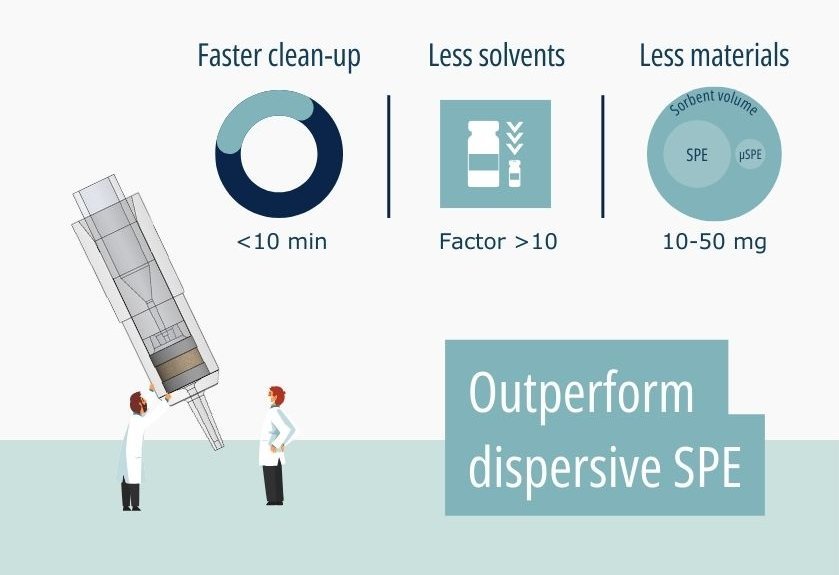
Superior Cleanup 🧼: The packed sorbent bed in the µSPE cartridge provides a much more efficient and selective cleanup than loose d-SPE powder. This leads to cleaner extracts, which significantly increases instrument uptime and ruggedness.
Full Automation 🤖: The PAL RTC automates the entire process - from conditioning the cartridge to loading the sample and eluting the cleaned extract - in as little as 8 minutes per sample. With "prep-ahead" scheduling, the PAL System prepares the next sample while the current one is running on the GC-MS, maximizing throughput.
Green Analytical Chemistry 🌱: The miniaturized format drastically reduces solvent and sorbent consumption, aligning perfectly with the principles of Green Analytical Chemistry (GAC).
Enhanced Precision & Traceability 📊: Automation eliminates manual variability, leading to exceptional precision. Every step is digitally controlled and logged, ensuring full traceability.
Broadening Horizons: Diverse Applications for Automated µSPE
While the QuEChERS workflow is a major application, the flexibility of the PAL System with µSPE technology extends to many other analytical challenges. The core principles of selective extraction and cleanup can be applied to a wide range of compounds and matrices.
Targeted Analysis of PFAS
The analysis of per- and polyfluoroalkyl substances (PFAS) is a critical task in environmental analysis. PAL System offers a robust solution for this challenge, providing a range of PFAS-free consumables to minimize background contamination. An established workflow for seafood analysis demonstrates how a QuEChERS-style extraction can be combined with automated µSPE cleanup to achieve sensitive and reliable quantification of PFAS by LC/MS, meeting stringent regulatory requirements.
In metabolomics and lipidomics, complex samples often contain lipids in a wide dynamic range, where high-abundance species can mask the detection of low-abundance ones. Automated µSPE can be used in an "enrichment mode" for sophisticated class fractionation of lipids. For instance, a single organic extract can be automatically processed through a mixed-mode µSPE cartridge to separate it into distinct fractions, such as neutral lipids, free fatty acids, and phospholipids . This approach helps to equalize the abundance of different lipid classes, preventing detector saturation and enabling a more comprehensive analysis of the lipidome.
These examples demonstrate how the PAL System with µSPE is a versatile platform for both cleanup (scavenging) and enrichment, addressing complex sample preparation challenges across various fields of research.
Your Local Partner for Automation: Brechbühler AG
While we at PAL System provide the technology for such automation, our partners at Brechbühler AG provide the local expertise, sales, and support to bring these solutions to your laboratory in Switzerland. They are your direct contact for implementing robust, efficient, and green analytical workflows.
Connect with the Brechbühler team to discuss how automating your sample preparation with the PAL System can transform your lab's productivity.