A Conversation with Madison L. Williams on Volatile PFAS and Automated Microextraction
We often refer to PFAS as "forever chemicals," but this label misses a critical dynamic: the "forever cycle." While regulatory efforts focus on removing persistent ionic compounds from our water and soil, a hidden reservoir of volatile "neutral" precursors circulates in the air. These mobile molecules travel unseen, eventually degrading and transforming back into the very ionic PFAS we are trying to eliminate—continuously replenishing the pollution supply.
Breaking this cycle requires catching these "slippery" airborne precursors before they transform. To do that, researchers need precise, robust, and automated analytical workflows capable of trapping volatile compounds without losing them.
At the University at Buffalo, Madison L. Williams (Ph.D. candidate, Gionfriddo Group) is at the forefront of this analytical challenge. Her recent work, published in Analyst and highlighted in our latest Application Note, provides a critical comparison between traditional SPME Fiber and the robust SPME Arrow for trapping these elusive compounds.
We sat down with Madison to discuss the mechanics of this "forever cycle," her journey from organic synthesis to analytical chemistry, and howautomation helps to optimize complex extraction methods.
About Madison L. Williams
Madison L. Williams is a Ph.D. candidate in Prof. Emanuela Gionfriddo’s group at the University at Buffalo, The State University of New York. Madison’s work focuses on understanding the accumulation and sorption phenomena of emerging organic micropollutants into biopolymers via biomimetic solid phase microextraction (SPME). Madison is a co-author of various research and review papers and is currently focusing on the development of effective preconcentration and quantification strategies for the analysis of volatile PFAS in liquid and gas phases.
The Interview
Question 1. Your work in the Gionfriddo Lab at the University at Buffalo addresses some of the most persistent environmental contaminants of our time. What originally drew you to analytical chemistry, and specifically to the challenge of analyzing PFAS?
I didn’t start out as an analytical chemist; rather, my undergraduate research was rooted in organic synthesis. During my senior year as an undergraduate, however, I was hired by a regulatory laboratory to analyze water samples for a range of analytes, including ammonia, phosphate, nitrate + nitrite, and chloride, using established EPA methods. While I was generally aware of soil and waterway contamination by anthropogenic chemicals, observing the concentrations present in certain samples firsthand was eye-opening. That experience shifted my perspective and motivated my interest in analytical chemistry, as I wanted to better understand how to detect and analyze these analytes. PFAS represented a natural progression of this interest. Due to their ubiquity across environmental compartments and their known detrimental impacts, there is an essential need to expand their ‘toolbox’ for analysis. The Gionfriddo laboratory has provided the opportunity to pursue this focus.
Question 2. In your research, you emphasize that while ionic PFAS (like PFOS and PFOA) get the spotlight, neutral volatile precursors are often overlooked. Why is it so important for environmental monitoring to shift its gaze toward these neutral precursors, and why have they historically been so difficult to analyze compared to their ionic counterparts?
It is not a matter of shifting its gaze, but of opening both eyes to the PFAS problem. Ionic PFAS represent a portion of overall PFAS emissions; if neutral precursors are not accounted for, the totality of PFAS sources will never be fully understood. In general, neutral precursors, such as fluorotelomer alcohols (FTOHs) and sulfonamides (FOSAs) are more volatile, mobile, and readily exchanged between indoor materials, air, dust, and the outdoor environment. Consequently, these compounds play a disproportionate role in long-range transport and the delayed formation of persistent ionic PFAS. Beyond serving as upstream contributors to legacy ionizable PFAS in the environment, neutral precursors also represent a significant and often underrecognized pathway for human exposure.
Despite this relevance, volatile precursors have historically been understudied, in part because conventional sample-preparation approaches developed for ionic PFAS are not readily applicable to neutral precursors due to their (1) lack of charged functional groups, (2) increased volatility, and (3) the absence of standardized analytical methodologies. Moreover, while liquid chromatography–electrospray ionization–tandem mass spectrometry (LC–ESI–MS/MS) is routinely employed for ionizable PFAS, it faces inherent limitations for neutral and short-chain precursors (e.g, FTOHs). Including ionization suppression from buffered mobile phases and the poor ionizability of PFAS with high fluorine-to-carbon (F:C) ratios, and, critically, the volatility of certain compounds, which can hinder retention and quantification.
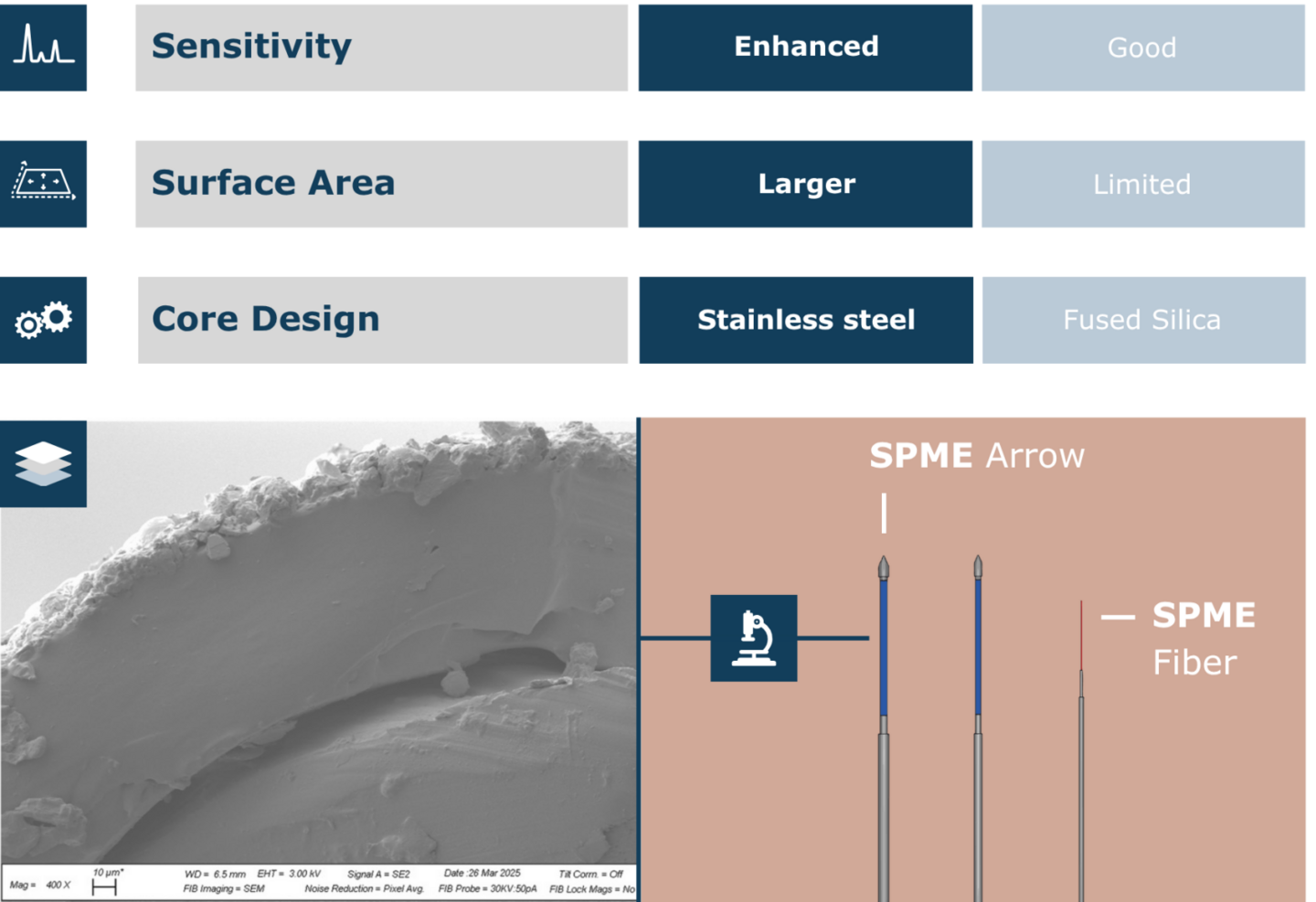
Question 3. Your study systematically compared traditional SPME Fibers with the newer SPME Arrow geometry. You found that while the Arrow offered broader linear dynamic ranges for fluorotelomer alcohols (FTOHs), the Fiber actually performed better for hydrophobic semi-volatiles like MeFOSE. Were you surprised that the larger volume of the Arrow wasn't automatically "better" for every analyte? How should a method developer decide between the two when setting up a new workflow?
From a method-development standpoint, our results indicate that selection of SPME geometry should be informed by analyte physicochemical properties rather than sorbent volume alone, and we were not surprised that increased coating volume did not uniformly translate to improved performance. The SPME Arrow demonstrated broader linear dynamic ranges for fluorotelomer alcohols (FTOHs), whereas the traditional SPME Fiber exhibited an increased range for the more semi-volatile analyte MeFOSE. To achieve balanced performance across the full set of volatile PFAS, method optimization required the selection of compromise conditions for optimal extraction. As SPME Fibers and Arrows differ in coating capacity and extraction kinetics, the use of such compromise conditions may contribute to the observed differences in analyte response between geometries. In practice, this suggests that geometry selection should be aligned with analyte behavior and analytical objectives, rather than assuming larger coatings will universally improve performance
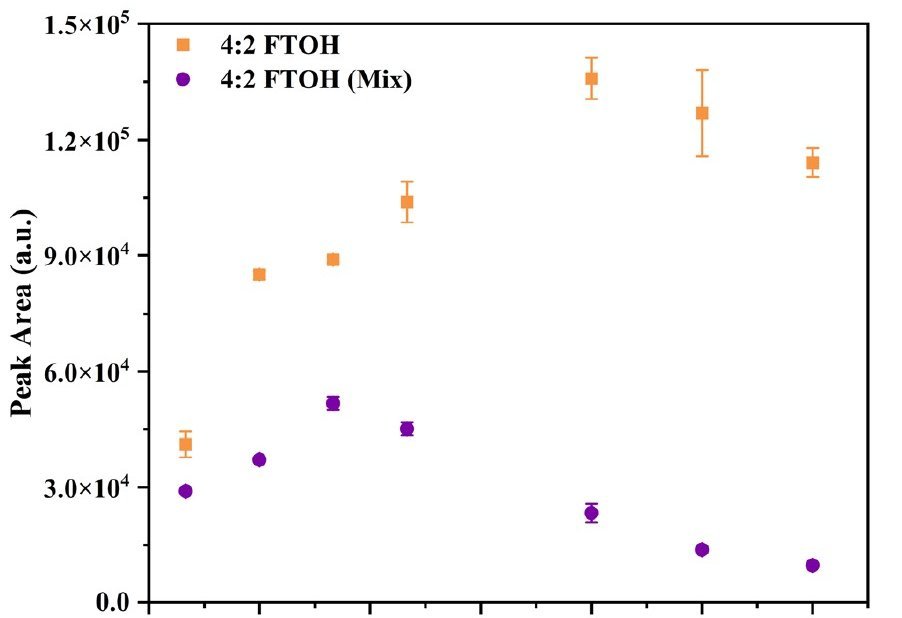
Question 4. Your data suggested that competitive adsorption begins to occur at extraction times longer than 35 minutes, where volatile compounds like 4:2 FTOH are displaced by higher-affinity analytes. How does this finding change the way researchers should approach optimizing extraction times for multicomponent mixtures?
Our data indicated that for multicomponent mixtures, when using an adsorbent type of extraction phase (e.g., DVB/C-WR/PDMS), competitive adsorption for the more polar hydrophilic volatile PFAS can occur after prolonged extraction times (35 min +). Under these conditions, extended exposure allows higher-affinity analytes to displace more weakly retained species from the extraction phase. These results underscore the need for a balanced, data-driven approach to extraction time selection when targeting chemically diverse analytes, where extraction time is chosen to accommodate multiple compounds while minimizing competitive displacement, rather than defaulting to longer extraction times. Additionally, the selection of sorbents not susceptible to this effect (e.g., polyacrylate) is an important consideration for minimizing its occurrence.
Question 5. SPME is often cited as a cornerstone of Green Analytical Chemistry because it integrates sampling and extraction without solvents. As we look toward the future of environmental analysis, where do you see the role of microextraction technologies evolving? Do you think we will see tools like SPME Arrows replacing standard solvent extractions in regulatory workflows?
As environmental monitoring increasingly emphasizes sustainability alongside analytical performance, microextraction technologies are well aligned with Green Analytical Chemistry principles due to their minimal solvent use and reduced analytical footprint. Looking ahead, these techniques are likely to play an increasingly targeted role in environmental analysis, particularly as the field moves toward automatable, miniaturized workflows designed to address low sample volumes, complex matrices, and emerging contaminants. Tools such as SPME Arrows offer advantages in solvent reduction and automation, and their flexibility to operate in either direct immersion or headspace modes enhances compatibility with complex matrices, making them attractive alternatives to existing sample preparation regulatory workflows. Rather than broadly replacing solvent-based extractions, tools such as SPME Arrows are more likely to be integrated selectively into regulatory workflows for applications where their advantages are clearly demonstrated.
Question 6. Research is rarely a straight line. During the development of this method, was there a specific moment of frustration that turned into a breakthrough, or a piece of data that surprised you?
As my advisor Professor Gionfriddo emphasizes, that is precisely why it is critical to pause at each step of the process to review and interpret the data obtained. In this project, that moment came when we initially noticed the phenomenon of competitive adsorption. What started as a “routine” extraction time profile, led us down a rabbit hole of inquiry in which we were able to systematically determine the underlying phenomenon.
Question 7. Now that you have characterized these geometries for volatile PFAS, what is the next big question you are hoping to answer in your Ph.D. journey?
Having characterized how extraction geometry and agitation impact extraction efficiency for volatile PFAS, the next major question we are interested in is how SPME devices can perform across increasingly realistic and complex matrices. Specifically, I want to understand how matrix composition, coating phase chemistry, and physiochemical properties of neutral PFAS can influence partitioning, sampling, and preconcentration. Ultimately, the goal is to use the systematic insights gained from our comparison of SPME geometries to inform method design and interpretation when moving from controlled systems to real samples
Question 8. Finally, to wrap things up on a lighter note: A Ph.D. is a marathon, not a sprint. What are the top three items in your "Survival Kit" (music/playlists, specific snacks, hobbies, or lucky charms) that are currently powering you through the long days of instrument runs and data processing?
For long days of instrument runs and data processing, a few things have certainly become essential. The first is music, since each instrument seems to have its own personality, I ended up creating different playlists to match whichever one I’m working on that day, it’s a small but fun way to change things up. I even have a dedicated maintenance playlist for those days it’s time to vent and clean the GC source. The second is stepping away, usually a short walk helps reset my thinking and makes it easier to come back to data interpretation with fresh eyes. The third isn’t necessarily an item, but more of a perspective, unexpected results are a part of science and allowing myself to be curious about them rather than viewing them as something ‘bad’ has made a big difference in staying motivated, particularly for those projects where it feels like nothing goes as planned.
Further Reading & Resources
Webinar: Automated PFAS Analysis with Madison Williams
Application Note: Optimizing the Preconcentration of Volatile PFAS Precursors
Original Paper: Williams, M. L., Cretnik, S., Lüthy, L., Flug, T., Stebler, M., & Gionfriddo, E. (2025). Comparison of solid phase microextraction geometries for effective preconcentration of volatile per- and polyfluoroalkyl substances. Analyst, 150, 1234-1245.
Optimizing the Preconcentration of Volatile PFAS Precursors - A Comparative Study of SPME Geometries
This Application Note summarizes a study by Williams et al. (2025) that performs a comprehensive comparison of two Solid Phase Microextraction (SPME) geometries: the traditional SPME Fiber and the robust SPME Arrow. The study systematically evaluates the impact of SPME geometry and extraction mode (Headspace vs. Direct Immersion) on extraction efficiency. The results provide a clear, data-driven basis for method development, showing how SPME configurations can be optimized for the specific physicochemical properties of different PFAS analytes.
Micromethods - Modern SPME Geometries - A Focus on Volatile PFAS Analysis
If you're looking for ways to improve your analysis of complex matrices or trace contaminants, these expert-led sessions are for you
Join us for a deep dive into recent research comparing SPME Fiber and SPME Arrow for ultra-trace volatile PFAS. Learn directly from the author which geometry and extraction mode provides the best performance.
PFAS in Cosmetics -A Comparative Analysis of Sample Preparation Techniques for PFAS Analysis
This application note explores a comparative study that tackles this challenge head-on by evaluating two powerful sample preparation techniques: Solid Phase Microextraction (SPME) and Micro Solid Phase Extraction (µSPE) for analyzing eight key PFAS in mascara by Liquid Chromatography with Mass Spectrometry (LC/MS). The investigation revealed that the two methods offer complementary strengths. SPME proved more sensitive for water-soluble PFAS and offered a simpler, filtration-free workflow. In contrast, automated µSPE excelled for oil-soluble PFAS but required a sample filtration step.
The world of PFAS analysis is demanding, with tightening regulations and complex sample matrices pushing laboratories to their limits. This complimentary webinar series cuts through the noise, offering practical, expert-led guidance on how automated sample preparation can transform your workflows. Explore our webinars to learn how to boost sensitivity, ensure reproducibility, and tame the forever chemicals for good. We will touch on different sample workflows as well as spotlight different matrices, from food & food safety to environmental sample types.
Micromethods - Automated µSPE Cleanup for High-Throughput QuEChERS Analysis
If you're looking for ways to improve your analysis of complex matrices or trace contaminants, these expert-led sessions are for you
Tired of manual uSPE? See how a fully automated, miniaturized µSPE workflow provides a superior cleanup for tough matrices like fats, oils, and spices, helping you reduce instrument maintenance and improve reproducibility.
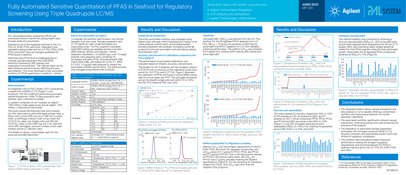
This application note showcases a fully automated workflow for the precise quantification of 73 PFAS in seafood. Utilizing a PAL RTC autosampler and Agilent triple quadrupole LC/MS system (LC/TQ), the method automates calibration, QuEChERS extraction, and μSPE clean-up.
Measuring PFAS is challenging due to their persistence, complex chemical nature, and presence at extremely low levels (parts per trillion) in environmental samples. Rigorous sample preparation, advanced analytical instrumentation, and robust quality control are essential for reliable PFAS quantification.
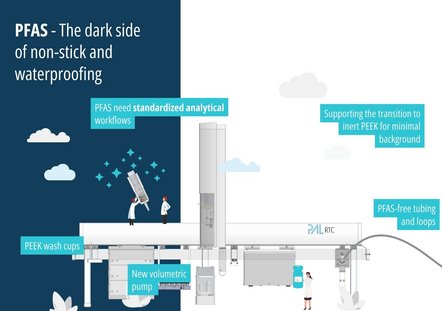
PAL System focusses on PFAS-free tubing, tools, and modules enabling:
Fully automated workflows
Specialized LC/MS tools
Multi valve setups for increased productivity using online SPE
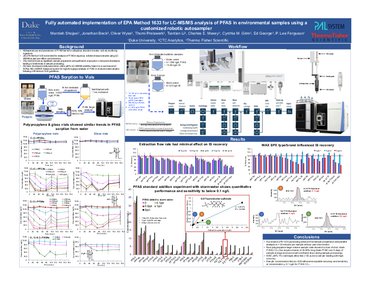
ASMS 2025 - Fully automated implementation of EPA Method 1633 for LC-MS/MS analysis of PFAS in environmental samples using a customized robotic autosampler
Widespread use and persistence of PFAS has led to ubiquitous detection in water, soil, air, and living organisms.
US EPA Method 1633 is intended for analysis of PFAS in aqueous, solid and tissue samples using LCMS/ MS at part-per-trillion concentrations.
This method involves significant sample preparation and purification steps prior to instrumental analysis, leading to bottlenecks in sample processing.
We have developed a fully automated, online μSPE-LC-MS/MS workflow based on a customized LC TriPlus RSH SMART Advanced system for high-throughput analysis of PFAS in environmental samples following EPA Method 1633 guidelines
ASMS 2025 - Fully Automated Sensitive Quantitation of PFAS in Seafood for Regulatory Screening Using Triple Quadrupole LC/MS
Detecting trace PFAS level is challenging due to complex sample preparation like QuEChERS extraction followed by SPE cleanup, and evaporation/reconstitution. The manual steps can be labor-intensive and error-prone, affecting accuracy and reliability. This study developed a fully automated workflow for PFAS quantitation in seafood – shrimp.
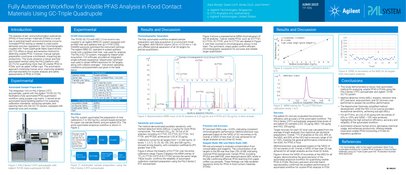
ASMS 2025 - Fully Automated Workflow for Volatile PFAS Analysis in Food Contact Materials Using GC-Triple Quadrupole
Gas Chromatography coupled with Triple Quadrupole Mass Spectrometry (GC/TQ) offers a robust and sensitive method for detecting volatile PFAS. However, manual sample preparation could pose a bottleneck, impacting lab productivity. This study presents a robust and fully automated method using the PAL3 platform with GC/TQ for quantifying more than 30 volatile PFAS in FCMs, such as paper coffee cups. The automation approach minimizes human error, improving reliability and reproducibility for routine analysis and safety assessments of PFAS in FCMs.