Story
Sample Prep
5 min 12.01.2025

Green Speed vs. Deep Biology

The days of relying solely on the toxic Folch and Bligh & Dyer methods for lipid extraction are numbered. As laboratories pivot toward "Green Analytical Chemistry," the focus has shifted to safer solvents like Methyl-tert-butyl ether (MTBE) and energy-efficient techniques like Microwave-Assisted Extraction (MAE).

But as new methods emerge, another question arises: Are we sacrificing biological depth for speed?

A collection of recent studies—ranging from pistachio analysis to clinical multi-omics—paints a complex picture. The consensus? There is no "one size fits all." Instead, the modern lab must choose between Rapid Green Extraction and Deep Multi-Omics Profiling, with automation acting as the essential bridge between them.

Gegner Hagen
Hagen Gegner

Scientific Communications Specialist

Visit Bio

The Case for Microwaves

For laboratories focused purely on lipid recovery, Microwave-Assisted Extraction (MAE) is proving to be a powerhouse.

A recent study by Bellinghieri et al. (2026) demonstrated that MAE combined with MTBE achieved the highest lipid yields (~39%) from raw pistachios, outperforming traditional Soxhlet extraction while preserving thermolabile fatty acids. This isn't an isolated finding. Campaniello et al. (2024) applied MAE to soft cheese (mozzarella), successfully characterizing over 400 lipids across 18 subclasses, while Cavalluzzi et al. (2022) utilized MAE to recover bioactive antioxidants from lentil wastes.

The verdict from these studies is clear: if your goal is to extract lipids or robust phytochemicals quickly and sustainably, MAE is a proven, green winner.


Why Method Selection Matters

However, efficiency isn't the only metric. A study by Marques et al. (2022) compared different liquid-liquid extraction protocols (Bligh & Dyer, Matyash, and SIMPLEX) on serum samples. They found that the solvent composition significantly altered the profile of lipids identified. In other words, the method you choose dictates the biology you see.

This brings us to the "One-Pot" dilemma. While MAE is excellent for lipids, is it safe for the rest of the sample?


The Caution: Heat as a Catalyst for Transformation

Analytical chemists must remain vigilant about the effects of energy input. A review by Hu et al. (2021) highlights a critical risk: microwave radiation doesn't just heat a sample; it provides energy that can drive chemical reactions. Processes like oxidation, hydrolysis, and esterification can occur rapidly under microwave irradiation, potentially transforming original metabolites into artifacts.

For a targeted lipid assay, this might be acceptable. But for a holistic multi-omics study—where you aim to analyze labile metabolites and native proteins from the same vial—heating at 65°C is a dangerous game.

Why Automation Loves MTBE

For researchers seeking the "Deep Biology" picture, the Single-Sample Workflow published by Gegner et al. (2024) offers a robust alternative.

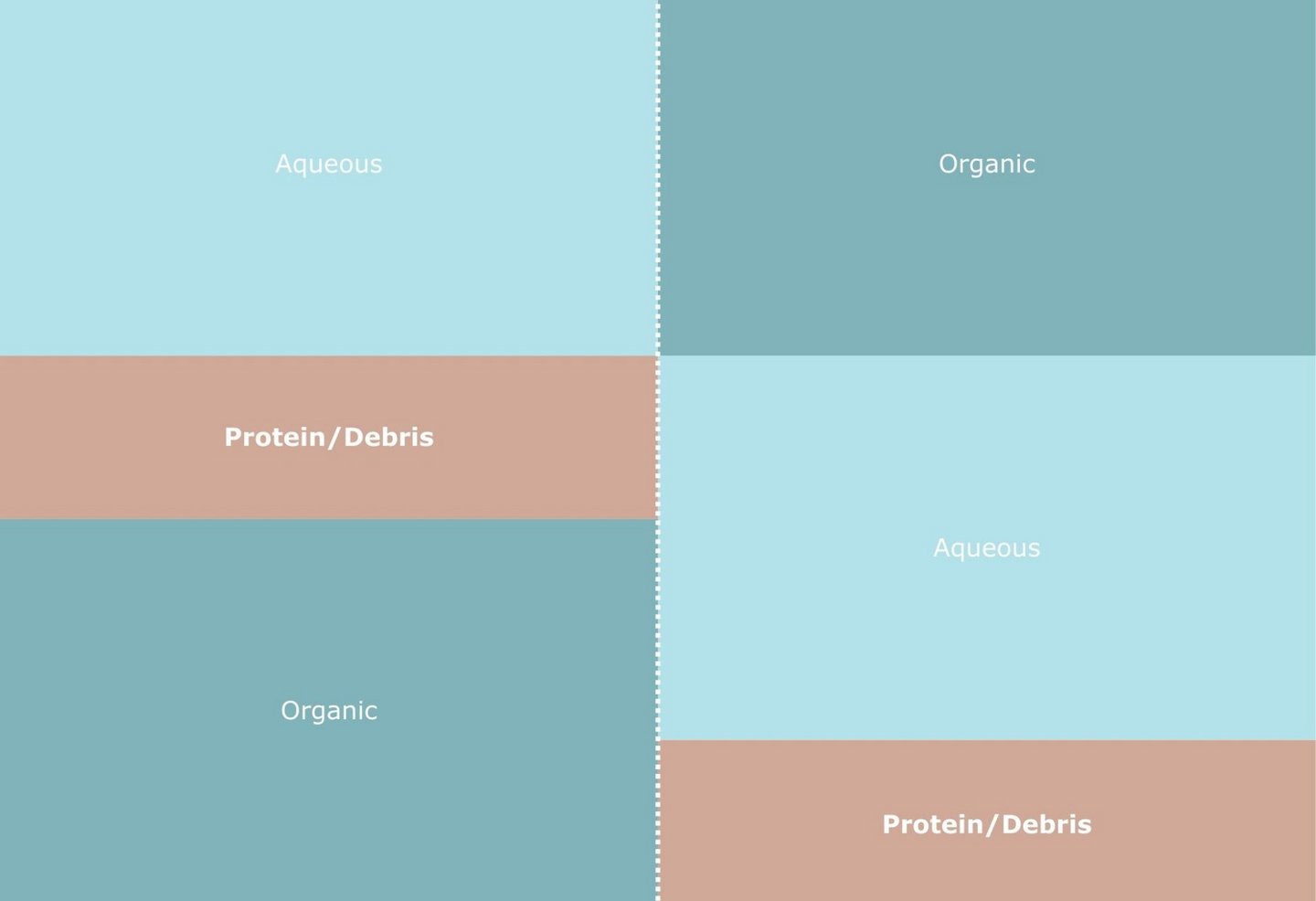
By adapting the Matyash method (using MTBE/Ethanol 75%) in a cold environment, this workflow allows for the simultaneous harvesting of three distinct layers from a single sample:

  1. Top Phase (Organic): Lipids

  2. Middle Phase (Aqueous): Polar Metabolites

  3. Bottom Pellet: Proteins

Crucially, this method avoids the protein aggregation and metabolite degradation associated with heat. It also leverages a massive advantage for automation: Phase Physics.

Unlike chloroform methods, where proteins form a messy interphase, the MTBE system forces proteins into a tight pellet at the very bottom of the vial. This allows the PAL System to cleanly aspirate the lipid and metabolite layers without disturbing the proteome, which can then be processed via automated SP3 protocols for proteomics.


Pro Tip: Automating High-Res Lipid Fractionation

Advanced lipidomics often requires more than just a crude extract. For deep coverage, separating lipid classes before analysis is key.

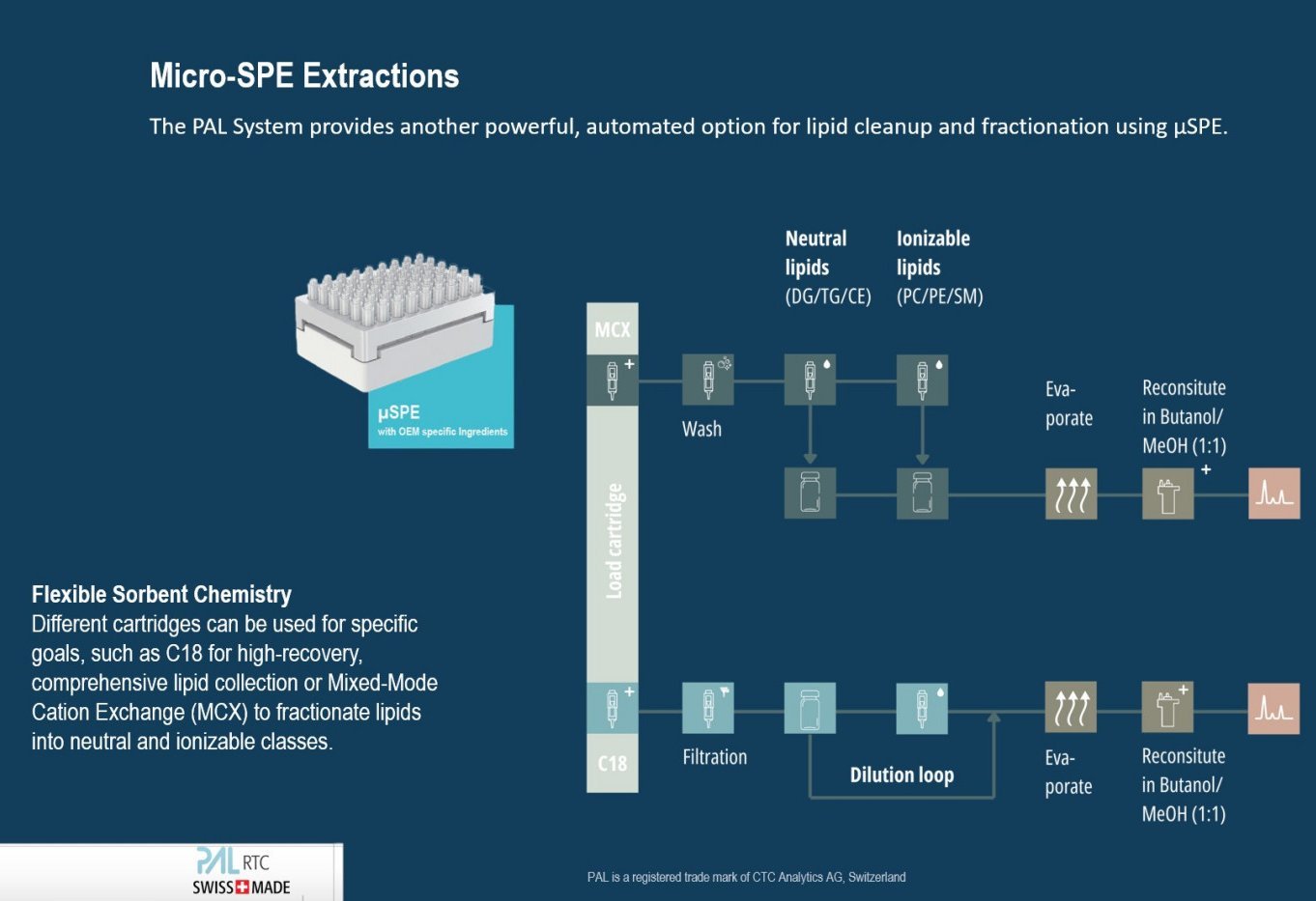
Recent collaborations have highlighted the power of the PAL System Micro-SPE (µSPE) modules for this purpose. In a refined lipidomics workflow, collaborators successfully automated the fractionation of lipids using Mixed-Mode Cation Exchange (MXC) cartridges.  The MXC cartridge retains phospholipids (which contain charged amine groups) while allowing neutral lipids to pass through.

This automated fractionation allows for the separate injection of neutral and phospholipid fractions, significantly increasing the depth of coverage in the mass spectrometer—all performed unattended by the robot.

The Next Horizon: Integral-Omics

As we balance speed and depth, the definition of "depth" continues to expand. While the single-sample workflow integrates three layers (Metabolome, Lipidome, Proteome), new research pushes the boundaries even further.

Li et al. (2025) recently introduced "Integral-Omics," a serial extraction strategy capable of profiling six distinct molecular layers—Metabolome, Lipidome, Genome, Transcriptome, Whole Proteome, and Phosphoproteome—all from a single biopsy tissue. This level of comprehensive profiling underscores the ultimate direction of the field: maximizing the information yield from every precious sample. As workflows evolve from "Green" to "Deep" to "Integral," the role of precise, automated liquid handling becomes not just a convenience, but a necessity to manage the increasing complexity of these serial extractions.


Conclusion

The analytical landscape is diversifying. We now have MAE-MTBE for rapid, green lipid extraction (Bellinghieri, Campaniello) and Cold MTBE-SP3 for deep, comprehensive multi-omics (Gegner).

The common denominator is the need for precision. Whether you are injecting a microwave-extracted lipid sample or fractionating a complex multi-omics extract via Micro-SPE, the reproducibility of the result depends on the reproducibility of the handling. By automating these distinct workflows on a PAL System, laboratories can flexibly switch between "Green Speed" and "Deep Biology" without compromising on data integrity. Even smaller automation processes, such as adding internal standards or dilutions/calibration curves, will improve the results noticeably.


References:

  1. Bellinghieri, C., Giacoppo, G., Schincaglia, A., Ferrara, D., Purcaro, G., Cavazzini, A., Pasti, L., Stevanin, C., Chenet, T., Marchetti, N., Maietti, A., Franchina, F.A., & Beccaria, M. (2026). "Applicability of MTBE-based lipid extraction methods assisted by microwave in food analysis. Statistical comparison and greenness evaluation with Soxhlet and Matyash." Talanta, 299, 129124.

  2. Campaniello, M., Nardelli, V., Zianni, R., Tomaiuolo, M., Miedico, O., Iammarino, M., & Mentana, A. (2024). "Microwave-Assisted Extraction/UHPLC-Q-Orbitrap-MS-Based Lipidomic Workflow for Comprehensive Study of Lipids in Soft Cheese." Foods, 13(7), 1033. doi.org/10.3390/foods13071033

  3. Cavalluzzi, M.M., Lamonaca, A., Rotondo, N.P., Miniero, D.V., Muraglia, M., Gabriele, P., Corbo, F., De Palma, A., Budriesi, R., De Angelis, E., Monaci, L., & Lentini, G. (2022). "Microwave-Assisted Extraction of Bioactive Compounds from Lentil Wastes: Antioxidant Activity Evaluation and Metabolomic Characterization." Molecules, 27(21), 7471. doi.org/10.3390/molecules27217471

  4. Gegner, H.M., Naake, T., Aljakouch, K., Dugourd, A., Kliewer, G., Müller, T., Schilling, D., Schneider, M.A., Rohrbach, N.K., Grünewald, T.G.P., Hell, R., Rodriguez, J.S., Huber, W., Poschet, G., & Krijgsveld, J. (2024). "A single-sample workflow for joint metabolomic and proteomic analysis of clinical specimens." Molecular Systems Biology, 20, 248–278.

  5. Hu, Q., He, Y., Wang, F., Wu, J., Ci, Z., Chen, L., Xu, R., Yang, M., Lin, J., Han, L., & Zhang, D. (2021). "Microwave technology: a novel approach to the transformation of natural metabolites." Chinese Medicine, 16, 87. doi.org/10.1186/s13020-021-00500-8

  6. Marques, M.S., Sussulini, A., Ferreira, P.C., & Pereira, T.F.D. (2022). "The Importance of Sample Preparation for Omics Analysis: Which Extraction Method is the Most Suited for my Biological Question?" Brazilian Journal of Analytical Chemistry, 10(40), 99-111. 

  7. Li, W., Sun, J., Sun, R., Wei, Y., Zheng, J., Zhu, Y., & Guo, T. (2025). "Integral-Omics: Serial Extraction and Profiling of Metabolome, Lipidome, Genome, Transcriptome, Whole Proteome and Phosphoproteome Using Biopsy Tissue." Analytical Chemistry, 97(2), 1190-1198.

Find more Webinars in the Content Hub
Micromethods - Automated µSPE Cleanup for High-Throughput QuEChERS Analysis
Webinars
Micromethods - Automated µSPE Cleanup for High-Throughput QuEChERS Analysis

Micromethods - Automated µSPE Cleanup for High-Throughput QuEChERS Analysis

If you're looking for ways to improve your analysis of complex matrices or trace contaminants, these expert-led sessions are for you

Tired of manual uSPE? See how a fully automated, miniaturized µSPE workflow provides a superior cleanup for tough matrices like fats, oils, and spices, helping you reduce instrument maintenance and improve reproducibility.


How to use PAL Method Composer

Standardized - From Study Design to Multi-Omics Integration in Metabolomics Workflows
Webinars
Standardized - From Study Design to Multi-Omics Integration in Metabolomics Workflows

Standardized - From Study Design to Multi-Omics Integration in Metabolomics Workflows

We will discuss common pitfalls, things to look out for, especially in the pre-analytical phase, extractions (from monophasic to biphasic extractions) and talk about the integration of different -omics.

At a glance:

  • Challenges in metabolomics sample preparation and studies
  • Significance of standardized protocols and automation
  • Integration of metabolomics and proteomics workflows
PFAS Webinar
Webinars
Webinar Series on Automated PFAS Analysis

Webinar Series on Automated PFAS Analysis

Forever chemicals, forever challenges?

The world of PFAS analysis is demanding, with tightening regulations and complex sample matrices pushing laboratories to their limits. This complimentary webinar series cuts through the noise, offering practical, expert-led guidance on how automated sample preparation can transform your workflows. Explore our webinars to learn how to boost sensitivity, ensure reproducibility, and tame the forever chemicals for good. We will touch on different sample workflows as well as spotlight different matrices, from food & food safety to environmental sample types.

Contact LinkedIn