Join experts to discuss two key micromethods: automated µSPE for food safety and SPME Arrow for environmental PFAS testing.
Story
Automation
2 min 10.29.2025

Micromethods Webinars: Automated µSPE & SPME

How can analytical labs improve data quality for complex matrices like honey or detect ultra-trace PFAS, all while reducing solvent waste?

The answer lies in "micromethods" - powerful, miniaturized sample preparation techniques that are setting new standards for efficiency and sustainability.

Gegner Hagen
Hagen Gegner

Scientific Communications Specialist

Visit Bio

Introduction

In the modern analytical laboratory, "micromethods" are rapidly moving from a niche concept to an essential strategy. These techniques are transforming sample preparation by fundamentally miniaturizing the process. This shift not only aligns with the principles of Green Analytical Chemistry (GAC) by drastically cutting down on solvent and sorbent consumption, but it also directly boosts laboratory efficiency, reduces manual variability, and improves data quality. To explore the practical benefits of these advanced approaches, we are hosting a special two-part webinar series.

These 15-minute expert sessions are designed to provide valuable, practical insights for your laboratory. Register today for one or both!

Even if you can't make the live session, register to receive the full on-demand recording afterwards.

Micromethods Webinar: SPME Geometries

Micromethods Webinar: µSPE Cleanup


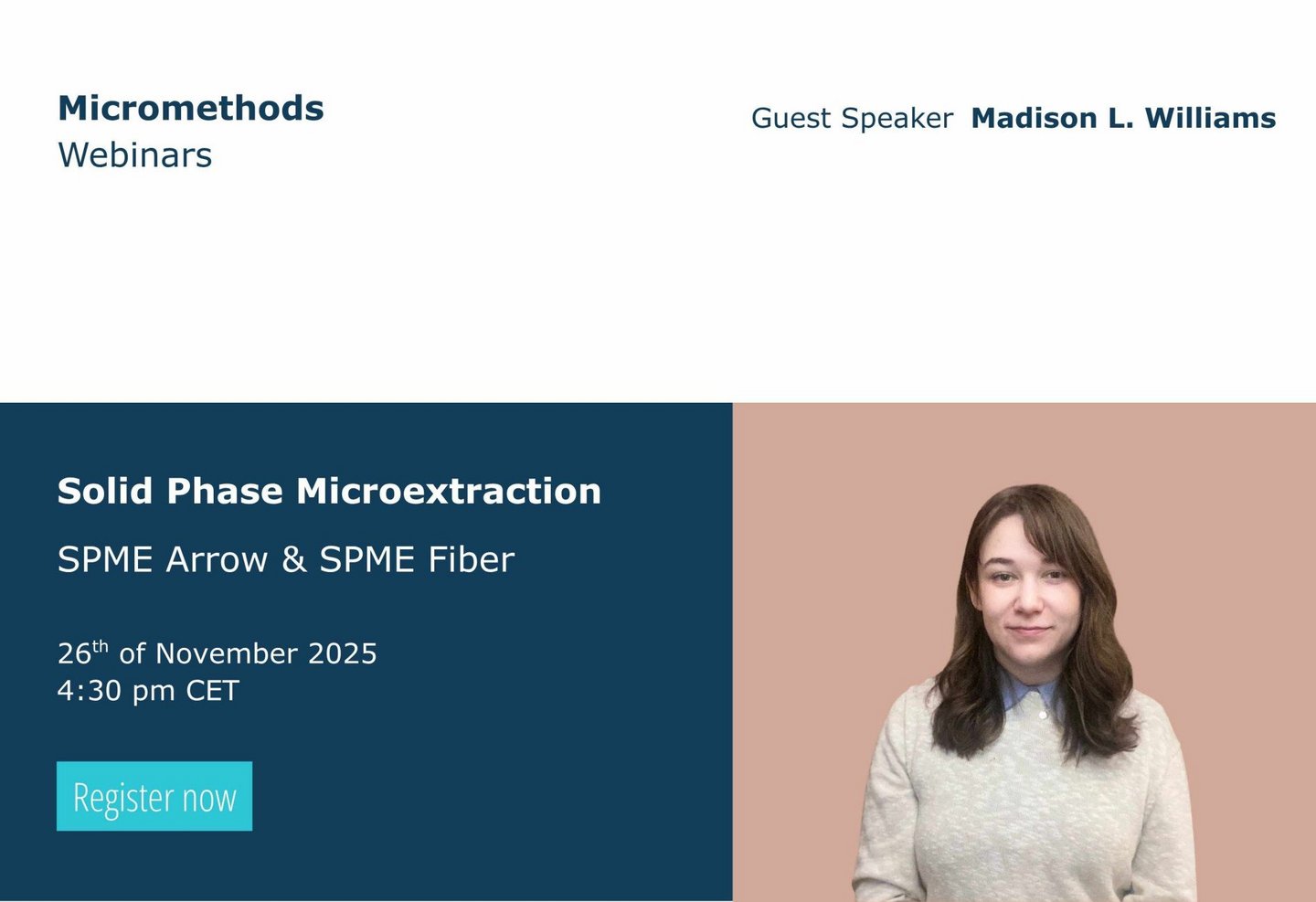
Webinar on SPME with Madison L Williams

Modern SPME Geometries for Ultra-Trace Contaminants

Date: 26th of November 2025, 4:30 pm CET

Guest Speaker: Madison L. Williams, University at Buffalo

We are honored to host Madison L. Williams, a Ph.D. candidate at the University at Buffalo, as our guest speaker. She will discuss her recent publication focusing on:

  • A direct performance comparison of SPME Fiber vs. SPME Arrow for volatile (FTOHs) and semi-volatile (MeFOSE) PFAS.

  • How the extraction mode (Headspace vs. Direct Immersion) and agitation mode affect extraction efficiency.

  • The broad range of applications that can be tackled with SPME.


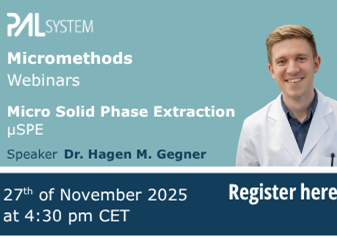
Automated µSPE for QuEChERS Analysis

Date: 27th of November 2025, 4:30 pm CET

Speaker: Dr. Hagen M. Gegner, CTC Analytics AG

The QuEChERS method is a global standard for pesticide analysis in food, but the manual dispersive SPE (dSPE) cleanup step is a well-known bottleneck. This step is labor-intensive, introduces variability, and often struggles with high-matrix samples like fats, oils, and pigmented spices. These "dirty" extracts lead directly to matrix effects and costly, frequent instrument maintenance. This webinar explores a "walk-away" solution using automated Micro Solid Phase Extraction (µSPE) cartridges. We will show how this automated, miniaturized workflow:

  • Provides a superior, more reproducible cleanup than manual dSPE.

  • Reduces solvent and sorbent consumption using miniaturized cartridges.

Find more Webinars in the Content Hub
Micromethods - Automated µSPE Cleanup for High-Throughput QuEChERS Analysis
Webinars
Micromethods - Automated µSPE Cleanup for High-Throughput QuEChERS Analysis

Micromethods - Automated µSPE Cleanup for High-Throughput QuEChERS Analysis

If you're looking for ways to improve your analysis of complex matrices or trace contaminants, these expert-led sessions are for you

Tired of manual uSPE? See how a fully automated, miniaturized µSPE workflow provides a superior cleanup for tough matrices like fats, oils, and spices, helping you reduce instrument maintenance and improve reproducibility.


How to use PAL Method Composer

Standardized - From Study Design to Multi-Omics Integration in Metabolomics Workflows
Webinars
Standardized - From Study Design to Multi-Omics Integration in Metabolomics Workflows

Standardized - From Study Design to Multi-Omics Integration in Metabolomics Workflows

We will discuss common pitfalls, things to look out for, especially in the pre-analytical phase, extractions (from monophasic to biphasic extractions) and talk about the integration of different -omics.

At a glance:

  • Challenges in metabolomics sample preparation and studies
  • Significance of standardized protocols and automation
  • Integration of metabolomics and proteomics workflows
PFAS Webinar
Webinars
Webinar Series on Automated PFAS Analysis

Webinar Series on Automated PFAS Analysis

Forever chemicals, forever challenges?

The world of PFAS analysis is demanding, with tightening regulations and complex sample matrices pushing laboratories to their limits. This complimentary webinar series cuts through the noise, offering practical, expert-led guidance on how automated sample preparation can transform your workflows. Explore our webinars to learn how to boost sensitivity, ensure reproducibility, and tame the forever chemicals for good. We will touch on different sample workflows as well as spotlight different matrices, from food & food safety to environmental sample types.

Contact LinkedIn