Discover a more sustainable approach to food safety. Micro-flow LC-HRMS significantly reduces laboratory waste in pesticide residue analysis without compromising sensitivity.
Story
LC/MS
4 min 03.16.2026

Green Food Safety: Reducing LC Solvent Waste by 25-Fold

The analytical requirements for pesticide residue monitoring in food continue to grow. Laboratories today face the dual challenge of increasing sensitivity for regulatory compliance while also striving for more sustainable, "greener" laboratory practices. A recent study published in Food Chemistry by Jesús et al. (2026) demonstrates a significant step forward by coupling micro-flow liquid chromatography with Q-Orbitrap high-resolution mass spectrometry (HRMS).

Gegner Hagen
Hagen Gegner

Scientific Communications Specialist

Visit Bio

Building on a Validated Foundation

The success of this comprehensive method relies on an optimized sample preparation workflow previously established by the same research group. In their 2023 study published in the Journal of Chromatography A, Manzano Sánchez et al. evaluated the transition from manual Dispersive Solid Phase Extraction (d-SPE) to automated cleanup using a PAL System (RTC).

That research highlighted that automated Micro Solid Phase Extraction (µSPE) provides several key advantages:

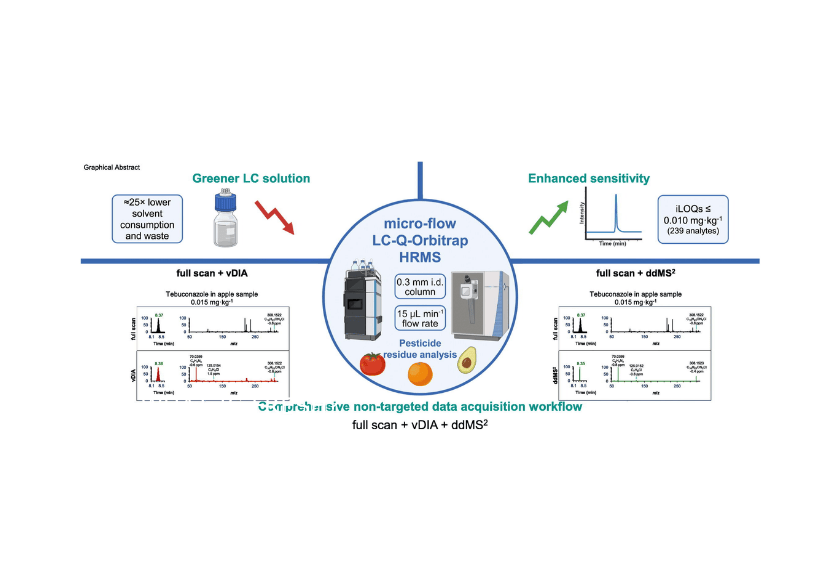
Graphical abstract: Pesticide residue analysis, micro-flow LC-HRMS, automated cleanup.

Enhancing Sensitivity through Miniaturization

In the latest work (Jesús et al., 2026), the team integrated this automated cleanup with a micro-flow LC-HRMS setup. By reducing the column internal diameter to 0.3 mm and operating at a flow rate of 15 μl⋅min -1, the method achieved:

  • Improved ionization efficiency through lower flow rates, which is essential for detecting pesticides at trace levels.

  • Reliable quantification of 239 pesticides at or below 0.010 mg⋅kg-1 in complex matrices like tomato, orange, and avocado.

  • A 25-fold reduction in solvent consumption and waste compared to traditional analytical-flow LC methods.


Data-Rich Monitoring

Beyond quantification, the use of a Q-Orbitrap platform allows for a sophisticated data acquisition workflow. By combining full scan MS with variable data-independent acquisition (vDIA) and data-dependent MS2 (ddMS²), the method creates a "digital footprint" of the sample. This allows researchers to perform targeted quantification today, while retaining the ability to conduct retrospective screening for emerging contaminants in the future without the need for additional injections.

This integrated approach—combining automated µSPE for reliable cleanup with the sensitivity of micro-flow LC-HRMS—provides a robust and efficient platform for modern food safety laboratories.


References:

Jesús, F., Díaz-Galiano, F. J., & Fernández-Alba, A. R. (2026). Coupling micro-flow liquid chromatography with Q-Orbitrap high-resolution mass spectrometry for greener, comprehensive pesticide residue analysis in fruits and vegetables. Food Chemistry, 508, 148447. https://doi.org/10.1016/j.foodchem.2026.148447

Manzano Sánchez, L., Jesús, F., Ferrer, C., Gómez-Ramos, M. M., & Fernández-Alba, A. R. (2023). Evaluation of automated clean-up for large scope pesticide multiresidue analysis by liquid chromatography coupled to mass spectrometry. Journal of Chromatography A, 1694, 463906. https://doi.org/10.1016/j.chroma.2023.463906

Find more Webinars in the Content Hub
Contact LinkedIn