A picture of the alps with a workflow an automated workflow and text saying Beatenberg, the location of the SGMS.
Event
Multi-omics
3 min 01.30.2025

SGMS 2024: A Hub for Cutting-Edge Mass Spectrometry Research

I had a fantastic time representing PAL System at the Swiss Group for Mass Spectrometry (SGMS) 2024 meeting!

It was a gathering of top experts in the field, all excited to share the latest and greatest in mass spectrometry. I presented a poster about an optimized way to analyze biological samples.

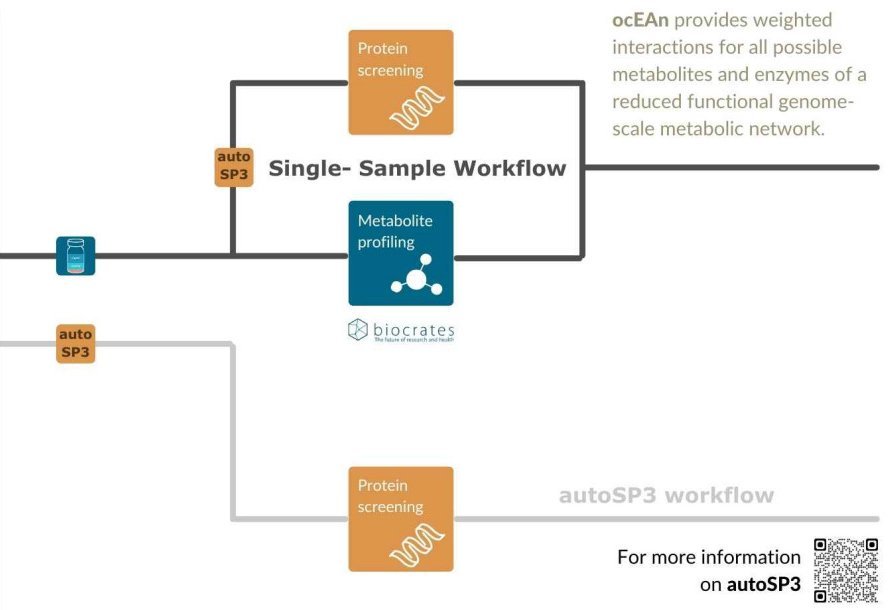
The exciting part? We can now get both protein and metabolic information from the same sample!

This means we can learn even more about diseases and develop better treatments. While this process can be automated, I only presented the proof of concept of this workflow based on a lung cancer cohort.


You can download my poster below or explore the publication behind it:

Gegner, H.M., Naake, T., Aljakouch, K. et al. A single-sample workflow for joint metabolomic and proteomic analysis of clinical specimens. 

Clin Proteom 21, 49 (2024). https://doi.org/10.1186/s12014-024-09501-9 


The SGMS meeting was buzzing with new ideas and discoveries:

  • Inspiring talks: We heard from amazing speakers like Albert Heck, Irene Chetschik, Philipp Weller, and Anton Kaufmann, who shared their knowledge on a variety of topics.
  • Cool research: From analyzing molecules to studying food chemistry, the meeting covered a wide range of fascinating applications of mass spectrometry.
  • Student stars: Congratulations to Anita Lopes Souto and Corina Meyer for their awesome research!


The SGMS meeting is a fantastic opportunity for scientists to connect and collaborate.

I am already looking forward to next year's meeting!

See you at SGMS 2025!


For more information around this years meeting visit: 2025 SGMS Meeting - Swiss Group for Mass Spectrometry - SGMS

Gegner Hagen
Hagen Gegner

Scientific Communications Specialist

Visit Bio

An illustrated workflow of a blood sample that is going through the MTBE-SP3 workflow. The data is integrated and compared at the end.

A Single-sample Workflow

Abstract

Integrating proteomic and metabolomic data provides crucial insights into cellular regulation and disease pathways. However, traditional workflows require separate samples and labor-intensive manual processing, introducing variability and limiting throughput. Here, we present "MTBE-SP3", a streamlined single-sample workflow combining optimized methyl-tert-butyl ether (MTBE) metabolite extraction with automated single-pot solid-phase-enhanced sample preparation (autoSP3) for proteins. This approach reduces inter-sample and technical variability, enhancing the robustness and explanatory power of multi-omics analyses. MTBE-SP3 is compatible with diverse biological matrices, including formalin-fixed paraffin embedded (FFPE) tissue, fresh-frozen tissue, plasma, serum, and cells, demonstrating broad applicability in clinical research. Further tested in a proof-of-concept study using a lung adenocarcinoma patient cohort, MTBE-SP3 coupled with a novel network analysis approach revealed consistent proteomic and metabolomic alterations between tumor and non-tumor adjacent tissue. Beyond its current capabilities, MTBE-SP3 holds the potential for further automation. Building on our experience automating sample preparation and injection in other workflows using x,y,z robotic platforms, we envision adapting this approach to streamline the MTBE extraction and injection steps in LC/GC-MS metabolomic analyses. This exploratory avenue could further enhance throughput, reproducibility, and standardization in multi-omics studies, solidifying the role of MTBE-SP3 as a valuable tool for clinical research and potential routine diagnostics

Related Content

A single-sample workflow for joint metabolomic and proteomic analysis ofclinical specimens
Posters
A single-sample workflow for joint metabolomic and proteomic analysis ofclinical specimens

A single-sample workflow for joint metabolomic and proteomic analysis ofclinical specimens

Integrating proteomic and metabolomic data enhances ourunderstanding of biological processes and diseasemechanisms. Traditional multi-omics workflows often requireseparate sample processing, leading to increased variability.To address this, we developed MTBE-SP3, an optimizedsingle-sample workflow that combines a 75% EtOH/MTBEmetabolite extraction with automated single-pot solid-phase-enhanced sample preparation for proteins.

Micromethods - Automated µSPE Cleanup for High-Throughput QuEChERS Analysis
Webinars
Micromethods - Automated µSPE Cleanup for High-Throughput QuEChERS Analysis

Micromethods - Automated µSPE Cleanup for High-Throughput QuEChERS Analysis

If you're looking for ways to improve your analysis of complex matrices or trace contaminants, these expert-led sessions are for you

Tired of manual uSPE? See how a fully automated, miniaturized µSPE workflow provides a superior cleanup for tough matrices like fats, oils, and spices, helping you reduce instrument maintenance and improve reproducibility.


Automated sample preparation in the proteomics laboratory
Application Notes
Automated sample preparation in the proteomics laboratory

Automated sample preparation in the proteomics laboratory

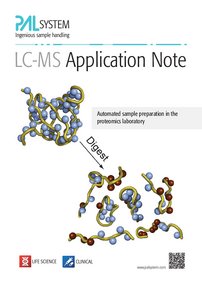
Automation of the digestion step provides a number of advantages, in particular for reproducibility, purity and time consumption. Unlike most other sample preparation systems the PAL RTC allows the preparation of smaller sample batches, which suites the medium-throughput requirements of a proteomic laboratory.

Streamlining Metabolomic Analyses with Automated Derivatization and Injection Workflows
Application Notes
Streamlining Metabolomic Analyses with Automated Derivatization and Injection Workflows

Streamlining Metabolomic Analyses with Automated Derivatization and Injection Workflows

Metabolites, the dynamic molecules reflecting cellular processes, hold the potential for understanding health, disease, and
biological systems. To unlock this potential, metabolomic analyses require precise and reliable analytical methods. This App Note
explores the workflow of the Metabolomics Core Technology Platform (MCTP), a core facility of Heidelberg University (Germany),
discussing their semi-automated analysis for untargeted metabolomics and ¹³C tracing studies via gas chromatography-mass
spectrometry (GC/MS).

Untargeted 2DxLC-Mass Spectrometry using SWATH-DIA-Based Workflow for the Characterization of Lipid Profiles in Plasma Samples
Posters
Untargeted 2DxLC-Mass Spectrometry using SWATH-DIA-Based Workflow for the Characterization of Lipid Profiles in Plasma Samples

Untargeted 2DxLC-Mass Spectrometry using SWATH-DIA-Based Workflow for the Characterization of Lipid Profiles in Plasma Samples

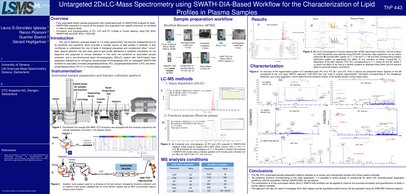
The use of lipidomic analyses based on LC-mass spectrometry has become widespread due to its sensitivity and specificity which provides a broader picture of lipid profiles in biofluids. In this work, we combined an automated sample extraction and a two-dimensional liquid chromatography (2DxLC) system with HILIC-based class separation followed by an orthogonal reverse-phase chromatography with an untargeted SWATH-DIA workflow to accurately annotate phosphatidylcholines (PC), lysophosphatidylcholine (LPC) and etherphosphatidylcholines (PC O-) in human plasma samples.

Contact LinkedIn