Environmental Market

Environmental Analysis

Environmental

Protection of our environment and our natural resources is crucial. Water, our most precious food, is also our most thoroughly controlled food. Whether it is drinking water, surface or waste water, the PAL System provides the tools and workflows for automated analysis of large sample series, even the continuous online sampling from water streams.

A common technique for the control of water quality is Solid Phase Microextraction (SPME). Using the SPME Arrow lowest levels of contaminants can be analyzed. Examples include geosmin and 3-MIB, as well as poly aromatic hydrocarbons (PAHs) or pesticides.

Similar SPME applications are used for the quality control of beverages, beer brewing, or also various kind of spirits. In addition, the classical static headspace (HS) or dynamic headspace analysis are available for routine water analysis.

Environmental contaminants in water, soil or sediments like personal care products (PCPs), pesticides or hormones use either the QuEChERS extraction with micro-SPE cleanup (uSPE), or SPME Arrow techniques.


Workflow Solutions

Discover our and our partners ready-to-go workflows.

Boreas compressed gas analysis

Compressed Gas Analysis

The Boreas is a robotic platform that can perform a high throughput analysis of compressed gas tanks, such as for SF6 purity testing. The PAL3 RSI based Boreas is integrated to a GC through a Chronos interface to enable the injection from the tanks directly to the analyzer.

More
Electrical transformer station used for power distribution, relevant to analysis of dissolved gas in oil for fault detection.

Dissolved Gas in Oil

The Oleo is a robotic platform that can perform a high throughput analysis of dissolved gas in oil by headspace, such as permanent gases, methane, ethane, ethylene, etc. In addition to being the perfect solution to test the quality of insulating oil, the PAL3 RTC based Oleo is also integrated to the GC through a Chronos interface to enable the injection.

More
EU Water Framework Directive - Chemical Contaminants in Surface Water

EU Water Framework Directive

Solvent free determination of 100 contaminants in surface Water by GC/MS meeting EU Water Framework Directive (EU WFD) requirements.

More
Illustration showing the chemical structure of glyphosate with a bee on a flower, representing analyzing of glyphosate and its impact.

Glyophosate

Complete workstation for the determination of glyphosate in food.

More
Gloved hand collecting a water sample from an algae-covered surface, illustrating environmental testing and H53 analysis.

H53

Measuring station for the fully automatic determination of the hydrocarbon index in water based on H53

More
Grilled sausages and vegetables on a barbecue, illustrating PAHs analysing in food stuff to assess contamination from grilling.

PAHs in foodstuff

Time saving and highly sensitive determination of PAHs

More
PAHs in Soil with HAPEX

PAHs in Soil

The HAPEX is a robotic platform that can perform a soil sample preparation for extraction, identification and quantification of environmental or chemical contamination such as polycyclic aromatic hydrocarbons (PAHs).

Gloved hand holding a test tube near apples and lab equipment, illustrating QuEChERS sample preparation in food testing.

µSPE Clean-up of QuEChERS Extracts

The µSPE clean-up of QuEChERS extracts for the analysis of pesticides and environmental contaminations is one example of how robotic instruments can alleviate the demands of sample processing faced by researchers.

More
VOCS in Soil
VOCS in Soil

VOCs in Soil

The Illo is a robotic platform that can perform a soil sample preparation for volatile organic compounds (VOCs) extraction, identification and quantification of environmentally or chemically contaminated material.

More

Reference Literature

Related Content

PFAS in Cosmetics -A Comparative Analysis of Sample Preparation Techniques for PFAS Analysis
Application Notes
PFAS in Cosmetics -A Comparative Analysis of Sample Preparation Techniques for PFAS Analysis

PFAS in Cosmetics -A Comparative Analysis of Sample Preparation Techniques for PFAS Analysis

This application note explores a comparative study that tackles this challenge head-on by evaluating two powerful sample preparation techniques: Solid Phase Microextraction (SPME) and Micro Solid Phase Extraction (µSPE) for analyzing eight key PFAS in mascara by Liquid Chromatography with Mass Spectrometry (LC/MS). The investigation revealed that the two methods offer complementary strengths. SPME proved more sensitive for water-soluble PFAS and offered a simpler, filtration-free workflow. In contrast, automated µSPE excelled for oil-soluble PFAS but required a sample filtration step.

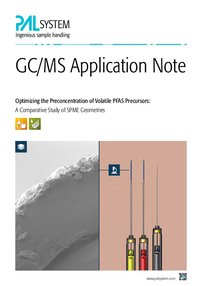
Optimizing the Preconcentration of Volatile PFAS Precursors - A Comparative Study of SPME Geometries
Application Notes
Optimizing the Preconcentration of Volatile PFAS Precursors - A Comparative Study of SPME Geometries

Optimizing the Preconcentration of Volatile PFAS Precursors - A Comparative Study of SPME Geometries

This Application Note summarizes a study by Williams et al. (2025) that performs a comprehensive comparison of two Solid Phase Microextraction (SPME) geometries: the traditional SPME Fiber and the robust SPME Arrow. The study systematically evaluates the impact of SPME geometry and extraction mode (Headspace vs. Direct Immersion) on extraction efficiency. The results provide a clear, data-driven basis for method development, showing how SPME configurations can be optimized for the specific physicochemical properties of different PFAS analytes.

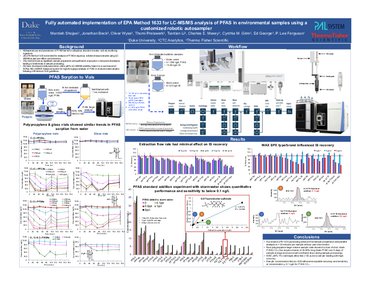
ASMS 2025 - Fully automated implementation of EPA Method 1633 for LC-MS/MS analysis of PFAS in environmental samples using a customized robotic autosampler
Posters
ASMS 2025 - Fully automated implementation of EPA Method 1633 for LC-MS/MS analysis of PFAS in environmental samples using a customized robotic autosampler

ASMS 2025 - Fully automated implementation of EPA Method 1633 for LC-MS/MS analysis of PFAS in environmental samples using a customized robotic autosampler

  • Widespread use and persistence of PFAS has led to ubiquitous detection in water, soil, air, and living organisms.
  • US EPA Method 1633 is intended for analysis of PFAS in aqueous, solid and tissue samples using LCMS/ MS at part-per-trillion concentrations.
  • This method involves significant sample preparation and purification steps prior to instrumental analysis, leading to bottlenecks in sample processing.
  • We have developed a fully automated, online μSPE-LC-MS/MS workflow based on a customized LC TriPlus RSH SMART Advanced system for high-throughput analysis of PFAS in environmental samples following EPA Method 1633 guidelines
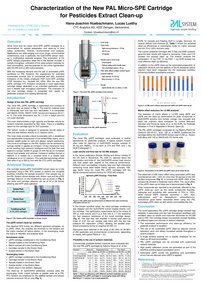
Characterization of the New PAL micro-SPE Cartridge for Pesticides Extract Clean-up
Posters
Characterization of the New PAL micro-SPE Cartridge for Pesticides Extract Clean-up

Characterization of the New PAL micro-SPE Cartridge for Pesticides Extract Clean-up

Since more than ten years micro-SPE (uSPE) emerged as a micromethod for sample preparation and clean-up in food safety, proteomics, forensic, environmental and analysis. Applications are wide-ranging and cover drugs, environmental contaminants, and, in particular, the QuEChERS extract cleanup in multiresidue pesticide analysis. The automation of the uSPE sample preparation steps led to the desired increase in sample throughput, unification of the used sorbent materials for food commodities, and the potential for the online hyphenation with GC/MS and LC/MS instrumentation.
 

Micro-SPE Webinar
Webinars
Advantages of automated and miniaturized uSPE clean-up in pesticides residues analysis

Advantages of automated and miniaturized uSPE clean-up in pesticides residues analysis

Recent developments in pesticides analysis extend the well-established methods to higher productivity and reliability while minimizing consumption and exposition to harmful chemicals. A workflow was developed that allows automatic preparation of calibration standards, automatic sample dilution, and automatic clean-up of sample extracts on one instrument, showing that miniaturized automated solutions are reducing errors, improving analytical consistency and protecting the environment in one convenient approach.

Presented by:

Thomi Preiswerk, Senior Account Manager, CTC Analytics AG

Gwen Lim , Specialist for automated sample preparation, CTC Analytics

Ederina Ninga, Postdoc, Research Group for Analytical Food Chemistry, Danish Technical University 


PFAS Webinar
Webinars
Advancing PFAS Analysis - Robotic Automation and Streamlined LC/MS Workflows

Advancing PFAS Analysis - Robotic Automation and Streamlined LC/MS Workflows

To support the scientific community and advance PFAS analysis we are proud to offer a webinar on this topic.

Key topics:

  • PFAS Fundamentals: Learn about the chemistry and significance of PFAS compounds.
  • Sample Preparation Challenges: Understand current hurdles, regulations and best practices in PFAS extraction and purification.
  • Automated LC/MS Workflows: Get an overview on automated workflows and see how PAL System integrates with LC/MS to optimize sample preparation and injection.
  • Deep Dive: Explore online SPE for PFAS analysis.
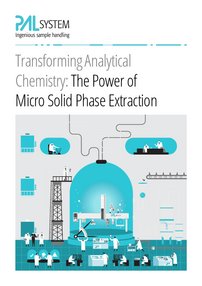
The Power of Micro Solid Phase Extraction
eBooks
The Power of Micro Solid Phase Extraction

The Power of Micro Solid Phase Extraction

This eBook explores the potential of uSPE to transform analytical workflows. It highlights the key benefits of uSPE, compares it with traditional techniques and examines its application across various industries. This resource provides a comprehensive guide for scientists and lab managers looking to optimize their sample preparation processes, achieve higher precision and embrace sustainable practices in analytical chemistry.

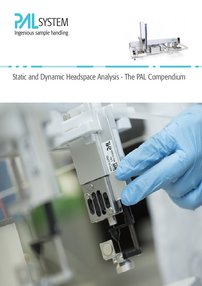
Static and Dynamic Headspace Analysis
eBooks
Static and Dynamic Headspace Analysis

Static and Dynamic Headspace Analysis

The PAL Compendium

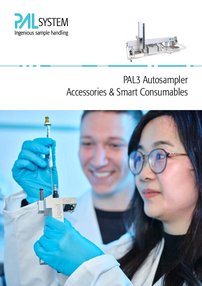
PAL3 Accessories & Smart Consumables
Brochures
PAL3 Accessories & Smart Consumables

PAL3 Accessories & Smart Consumables

Discover our Toolbox

Contact LinkedIn